
« Cabinet Level Blogging | Main | Microwulf - The World's Cheapest Supercomputer »
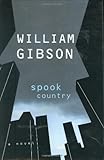
Spook Country
I just finished Spook Country, William Gibson’s latest novel. The book is a mystery, set in a world that could be today or the near future. Geolocative art is bigger than you might find to be the case today, but that’s about it. I liked Pattern Recognition quite a bit, but I think Spook Country is head and shoulders above it as a story.
Gibson’s writing is what I enjoy the most. It’s rare that I read a book that I find myself going back and rereading sentences or paragraphs just to savor the language. Gibson’s sentences can be dense and he doesn’t hit you over the head with his plot devices, but it’s just excellent writing. Here are a few examples. From page 9:
The old man reminded Tito or those ghost-signs, fading high on the windowless sides of blackened buildings, spelling out the names of products made meaningless by time.
And here’s one from page 208:
Earlier the track had passed near streets of tiny row houses, in neighborhoods where poverty seemed to have been as efficient as the neutron bomb was said to be. Streets as denuded of population as their windows were of glass. The houses themselves seemed to belong less to another time than to another country; Belfast perhaps, after some sectarian biological attack. The shells of Japanese cars in the streets, belly down on bare rims.
This was one of those books that you’re sorry to see end because you know it’s going to be a while before you read prose this good again.
Amazon has a video and Gibson’s original book proposal on their site. Very fun.

Posted by windley on August 30, 2007 8:52 PM


Comment from Chris Bradley at October 4, 2007 4:57 AM
A point blank review of Spook Country by William Gibson
Posted in Uncategorized by chrisbradley on the October 4th, 2007
Let’s get started on the best note possible. William Gibson stated yesterday in the California Literary Review that Spook Country was a “contractual obligation” and that he started with a “blank page” and found himself in “varying degrees of distress” during the task of publishing it.
For every reason stated above, and the fact that it is a dry uninspired read at best, it is not worth spending one red cent on. His work has become no better than Steven King’s work since the release of Pattern Recognition in 2003, and he is willing to admit, that he is no longer interested in writing about the future.
If I were tied to a “contractual obligation” I don’t think I would feel that inspired to write anything particularly new or different either. Especially if I were aware the Publishers were screwing me out of a good portion of the profits.
So, with these things in mind, lets talk about the story and the characters. Brown is a psychopathic failed government agent who is holding Milgrim hostage. Milgrim is addicted to psychotropic speed analogs. They are in New York at the start of the work. Hollis Henry, a pop singer from a band called the Curfew (not far from Curve or the Cure in name) has had a failed career and is making a last ditch effort as a Journalist for an Internet rag called the node. Except that she never writes a single significant word in the entire novel. The container she ends up searching for is ultimately filled with U.S. Government Money (literally 100.00 bills) and it is a ruse that makes her a possible target for a Chinese / Cuban group intent on tagging the money with Cesium. She starts in Los Angeles and Everyone ends up in Vancouver at the conclusion. The Cubans main characters are a kid named Tito and a guy with the Gun to tag the money inside the Shipping Container.
There is a bit about stealing a Glock from a drug dealer, and that’s about as much action as takes place in the book. The sequence in New York where Brown is madly trying to procure an Ipod containing data from Tito is a miserable, uninventive look at Union Square, and involves automobiles very rarely.
The big excitement in Milgrim’s life is getting a haircut and a Makeover paid for in Washington D.C. by Brown’s attache’s before boarding a Jetstream to Vancouver where he appears to lose his mind completely. Crashing a car in an attempt to kill Tito. At which point Milgrim escapes, snatches Hollis Henry’s purse which contains 5000.00 given to her by proxy from a dead band mate, heroin overdose, who could have figured? Which lands him in a bed and breakfast having a nice egg breakfast on his way out to roam the streets.
That about sums it up. There’s nothing more to it. It was the most uninteresting, formula driven work that Gibson has ever written. And the Locative art and GPS opening sequences with Bobby Chombo are so lost in the gratuitous waste of language that they are hardly worth reflecting on. It leaves a big “So what?” in my mind.
I am glad Gibson is admitting that his publishing company is doing him no good, and I suggest that he continue to do so, and “dropkick the chihuawa’s into the soup.” Because they are just like PRADA bags, trendy, hollow, purchased by vindictive people, and generally bred for all the wrong reasons.
I am glad I bought the book, but maybe Penguin Putnam should rethink their marketing strategy before alienating their customers with tripe that isn’t worth the toilet paper it was manufactured on. In today’s world, now that he is the Godfather of Cyberpunk, Gibson could have as easily signed his name on a bag of old tomatoes, and they would sell for $17.00.
And he knows it. And he will do it again.
0 Comments
10 Reasons Not To Buy Into Gibson Mythos
Posted in Uncategorized by chrisbradley on the October 3rd, 2007
1) While Gibson May Have Coined The Word Cyberspace, He Did Not Construct It. DARPA Did.
2) Cyberspace was good for all of 3 Books. Neuromancer, Count Zero, and Mona Lisa Overdrive. Every subsequent work dealt with other subjects - which were based solely on the trendiness of the times. Virtual Light (Virtual Reality), Idoru (artificial intelligence turned pop-star), and All Tomorrow’s Parties (the homeless problem). Pattern Recognition (Modern Marketing). Spook Country (Paranoia of the Government).
3.) I wrote a review of Pattern Recognition that was widely available to people seeking Gibson’s work. A few thousand people probably bought the work because of it. I didn’t receive a single thank you note from the Publisher of the work. Instead - I have repeatedly been asked to either stop publishing my own work, or leave their forum altogether.
4.) When I made my best efforts over the course of years from 2003 - 2007 to participate in the Gibson Forum, yes that is 4 years, I was ultimately harassed, shunned, insulted, and instigated into arguing with its members. They are a HOSTILE, Unpleasant, Self Righteous Bunch, With No Valid Intent to Read REAL meaningful posts and respond in a Non Hostile way.
5. The proprietors had me REMOVED from the forum for responding in kind. After having spent Several Hundred Dollars on Gibson Merchandise over the years and invested COUNTLESS hours studying Computer Science and Artificial Intelligence as a result of his works, you would think I would have something of a place there discussing the subjects.
6. Their forum patrons, PERSIST in posting hostile materials against my person, after I have left the forum. I know this because the forum has no measure in place from me ANONYMOUSLY viewing its content.
7. William Gibson, is not at the heart of the real matter at hand. The real matter at hand is that he probably signed a contract with Putnam that prohibits him from doing anything but writing Bestsellers. Therefore his work is Toned Down and not worth reading at all. It is Formula Work designed to shift units. He has little or no creative control over the end result as he did with Neuromancer.
8. A Publishing Company that has No Adequate Oversight over its own resources and the people that uses them has no business being a Publishing Company at all in today’s world. If they cannot prohibit users from behaving badly to one another on their website, because they do not interact with it to a significant degree, then they have no business running the website.
9. The Pattern Recognition Movie will probably sell a lot of tickets. Good for the Executive Producer. Bad for Gibson. Good for the publishers of the book - who hold sway over the Copyrights to it through contracts, bad for Gibson. Good for DVD sales and Wal-Mart, bad for Gibson. Good for Leather Jackets, bad for Gibson. Because he knows its not a real story. Its a story that took advantage of the 9-11 event, just like World Trade Center, which was a cheaply made story with a terribly mundane plot.
10. If you have any ambitions of being a writer, stay away from allowing a Publishing Company like Penguin Publishing to contract you. They only pay a few cents per copy sold, while with self publishing, not only are you your own boss, but the book is instantly available internationally, and you get paid up to 2 or 3 dollars a copy. Working the slave life isn’t anything anyone should aspire to.
0 Comments
An open letter to Penguin Putnam Group
Posted in Uncategorized by chrisbradley on the October 3rd, 2007
Leave a comment
I encourage you to leave a comment below. Your email address will not be displayed on Technometria, but allows me to communicate with you directly. Your email address won't be displayed, but will be used to compute a MicroID for your comment.