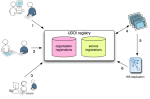
 UDDI interactions with various SOA players (click to enlarge) |
As part of the SOA governance feature and Infravio X-Registry review that are going to be in InfoWorld in a few weeks, I'm trying to come up with a short (less than 200 words) sidebar and graphic on understanding UDDI. My first draft of a graphic is shown on the right. Here's text I'm thinking of including with it. Naturally, it has been simplified to meet space requirements. The question is "does this capture the spirit of UDDI and communicate useful information or does it confuse because of details left out?" Help me out.
- Architects, in consultation with business users, populate the registry with abstract service specifications relevant to the business called technical models, or more commonly, tModels. tModels are registered and assign a unique identity, in the form of a long hexadecimal number, called a UUID.
- Business users, with the help of registry operators, populate the registry with information about the organization and it's units. Each entry also receives a UUID.
- Developers, in consultation with business users, populate the registry with services and classify them according to the tModels as well as industry and organizational taxonomies.
- Service consumers search the registry using various taxonomies for services that meet their needs.
- Discovered services are linked together to form Web Services applications.
- Applications can dynamically query the registry for service end points and other metadata.