

« CTO Breakfast This Friday | Main | A Simple Solution to Form Spam »

Flying to Richfield

Little Bryce Canyon
Little Bryce Canyon
(click to enlarge)

Last Saturday, Steve Fulling and I flew down to Richfield with my youngest son. The flight was all about breakfast and enjoying what turned out to be a beautiful summer morning. I was a little concerned that we’d run into smoke from the Milford Flat Fire (the largest wildfire in Utah recorded history), but it wasn’t an issue. In fact I was disappointed that there weren’t any cool firefighting planes at the Richfield airport.

I used the flight as an opportunity to see how well my iPhone would do with pictures. Here’s some pictures I took from the air with the iPhone. Not stellar, but OK. The best thing about the iPhone camera in my opinion, is that iPhoto recognizes it as a camera and starts up and transfers any pictures to my computer whenever I sync. That’s the behavior I want.

iPhoto’s treatment of iPhone photos, on the other hand, is abysmal. The “enhance” button does a pretty good job on pictures from my Canon, but always makes the iPhone pictures look grainy and unnatural. Your best bet, I’ve found, is to take pictures with the iPhone with plenty of light.
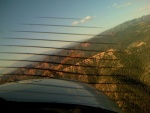
I'm not sure what the
verticle lines are.  They're caused by the propeller.  No camera has
done that before.
I’m not sure what the horizontal lines are.
(click to enlarge)

Can someone explain this picture to me? The picture is taken through the propeller. Most cameras ignore the prop or it turns out looking like a slight smudge in the picture. The iPhone created these horizontal lines. I’m sure there’s some physics explanation of the interference pattern or something at work here, but I don’t know what it is. Leave a comment if you’ve got an idea.

Posted by windley on July 18, 2007 7:29 AM

See related posts:

3 Comments

I think the the lines have something to do with the glass in the windshield and the way the light refracts off of it.. I noticed you only get it when shooting out the front. Also it could not be the prop as the lines are present before the prop. You should try to take a shot with a normal digital camera out the front in the same kind of lighting and see if you get the same kind of result. On other think you get a rainbow effect out of one of the side shots so I bet the same kind of effect out the front causes dark lines not rainbows.

Comment from Shayne Holmes at July 18, 2007 8:55 AM

My guess would be that the camera is interpolated, like TV scanlines, taking one picture with reduced resolution, then another, and hooking them together; that would explain the fact that you can see a propeller shape in the lines (the prop was there for the first shot, then not for the rest). But that would be awfully weird behavior in a camera...

I don't think it's interference patterns, I think it's a timing relationship between your camera sensor's shutter or scanning rate and the prop speed.

You probably haven't seen it before if you've
been using cameras with a CCD sensor with a global shutter.

If the iPhone has a Micron CMOS sensor, then it probably has an Electronic Rolling Shutter (ERS).

The ERS "collects the image data row by row, analogous to an open slit that scans over the image sequentially. Each row integrates the light when the slit passes over it. Therefore, the scanlines of the image are not exposed at the same time."

Many traditional film cameras have a focal plane shutter curtain, in which the slit moves once across the image plane.

The classic example of motion distortion, from a film camera with a focal plane shutter, is
http://www.rit.edu/~andpph/photofile-b/lartigue-1.jpg

Similarly, someone's digital camera has caused a helicopter blades to appear bent:
http://www.flickr.com/photos/cliftonfhicks/8798593/

In your case, you have sections of the image scanned at different sections of the prop's rotation.

Leave a comment

I encourage you to leave a comment below. Your email address will not be displayed on Technometria, but allows me to communicate with you directly. Your email address won't be displayed, but will be used to compute a MicroID for your comment.