
« Defrag: Web 2.0 and Security | Main | Dick Hardt on Trust »
Defrag: Making Interactions Explicit
Eric Nolin is being very explicit about sponsor talks at Defrag. No harm there—in fact, I like it. The sponsor talk is clearly labeled as such and right before lunch. Today, it’s Shane Pearson, from BEA. I interviewed him for Technometria (as part of our coverage of Defrag) a few weeks ago.
Shane said a couple of things that piqued my interest. One was referring to a McKinsey study on interactions on the workplace. He put of a graph about the evolution of managed assets showing that capital was the earliest and easiest asset to manage. Information was second and interactions are the latest asset that businesses want to manage. The money quote from the study:
Almost 85% of people have jobs that are largely or wholly about interacting with other people (rather than transforming raw materials, running machinery, etc.).
IT has always had a function that included managing people interactions, but we’ve largely relegated it to the bottom-line “saving money” side of things: zero-day start, make sure the phones work, run the email system efficiently, etc. We’ve not been about top-line, “making money” activities.
Shane asked “what if wanted to know what articles and blogs my co-workers were reading?” He the put up a slide that showed what Facebook might look like if it provided enterprise-friendly functionality.
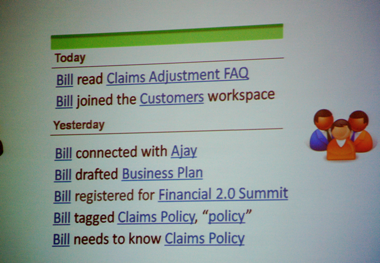
This got my attention. Maybe it’s been obvious to others, but I’ve informally done similar things with co-workers—shared what we’re reading—but this could make it more automatic. I’d welcome the opportunity to see more of what my co-workers think is interesting in any given day. Ironically, universities are particularly bad at this.

Posted by windley on November 5, 2007 1:35 PM


Comment from gregory at November 6, 2007 7:35 AM
nice segue between this post and the one following, wherein it is stated that the internet is not so good for intuition... the functional use of knowing what people are interested in via a software app is a great illustration of just how far from home the whole tech world really is... (home being defined as human awareness engaged in reality of present circumstances).... i mean, just ask your coworkers what they are up to... or just use your intuition to figure it out... but, no, we dont trust our own mind, we want tech... funny life
Comment from Craig Overend at November 6, 2007 7:42 PM
Anytime I see examples like that I think task triple:
Subject: Bill
Predicate: Connected with
Object: Ajay
I think the reason the semantic web is failing is because of the lack of tools for building social ontologies and the difficulty of designing in relationships. For a while I've been mulling over the idea of user-defined ontologies evolving with use of systems, rather than designing them from scratch in systems. I just don't see average users taking the time to structure their data.
Instead; a top down developer approach could be applied whereby systems would define application task specific relationships with ontology tasks. Community managed version concept maps could be used to find definitions for those task relationships. The pathway from one task definition version to another would be required for backward compatibility should the map change.
The idea still needs work but I think a dynamic historical system is what we need to manage our relationships. We do after all create relationships by what we do, not what we define.
-Craig.
Comment from Jared Ottley at November 10, 2007 1:09 AM
This (knowing and sharing what co-workers are doing) is a direction that Alfresco is heading. We see real power in Social Networking and are working towards adding those types of features into Alfresco, making it easy to share content (when we say content, we are not just talking documents, we are talking about knowledge, discussions, information, etc.) with coworkers through a common site. Alfresco already allows for RSS feeds to be placed on folders within the repository, so that when content is updated or added others can be notified of these changes. We also include discussion forums that follow content as it is moved within the repository. Being able see an equivalent to a Facebook mini-feed, around yours and others works is very powerful. We often seem to work in silos, but if we were to open up to being able to easily see just an idea of what someone else is working on, that may have a huge impact on what we are doing, or create discussion that helps improve process, or final product. Twitter and other micro-blogging software already does this to an extent. But having a single place to also include the documents that we are working on and an easy way of sharing those with others really adds strength to the notion that Social Networks are where the Enterprise needs go.
Leave a comment
I encourage you to leave a comment below. Your email address will not be displayed on Technometria, but allows me to communicate with you directly. Your email address won't be displayed, but will be used to compute a MicroID for your comment.