Summary
IIW XLII brought 287 people to the Computer History Museum in Mountain View for three days of sessions on identity, agents, and the legal and technical foundations of first person digital life. The agenda reflected a community grappling with real deployment challenges: SEDI and duty of loyalty, agentic identity, MyTerms, post-quantum cryptography, and the EUDI wallet. AIW2 followed on Friday, continuing the agentic internet conversation.
The Internet Identity Workshop met for the 42nd time at the Computer History Museum in Mountain View, California, April 28–30, 2026. As always, the Open Space unconference format let the agenda emerge from the people in the room. And, as always, the room delivered. Over three days and fifteen slots, participants convened 158 sessions spanning identity architecture, agentic systems, legal frameworks, cryptographic foundations, and the human stakes that tie all of it together.
We also held the second Agentic Internet Workshop (AIW2) on Friday, May 1, immediately following IIW. Like the first AIW last October, it used the same unconference format, this time with a sharper focus on how identity infrastructure supports autonomous agents operating on behalf of people.
Attendance
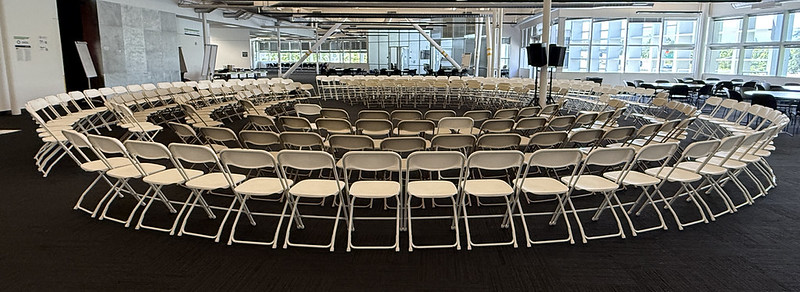
IIW 42 brought together 287 participants, matching last fall's IIW 41 exactly. That consistency is worth noting. There are lots of identity conferences now and the hype cycle pulls attention in every direction, but the identity community keeps showing up. The number reflects sustained interest in solving real problems. Because that's what IIW offers: space to solve problems. It's a workshop in thr true sense of the word.
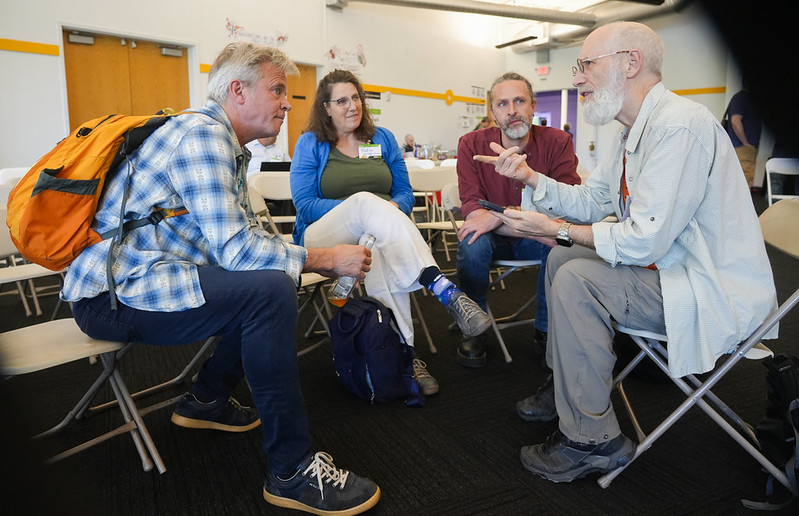
The hallway track was as rich as always. Some of the best conversations at IIW happen between sessions, at lunch, or during the demo hour, where people pull out laptops and show working code rather than slides. One of the reasons that meals are included at IIW is to keep the energy high and the conversations flowing.
Geographic Diversity
The geographic picture at IIW 42 was familiar in its broad strokes. The United States accounted for 229 of 287 attendees, with California leading the way at 119. San Francisco (19), San Jose (14), and Oakland (8) anchored the Bay Area contingent, while Seattle (7) and Los Angeles (7) rounded out the West Coast presence. Utah contributed 14 attendees, Texas 12, and Massachusetts 12, reflecting the distributed geography of the identity community within the U.S.
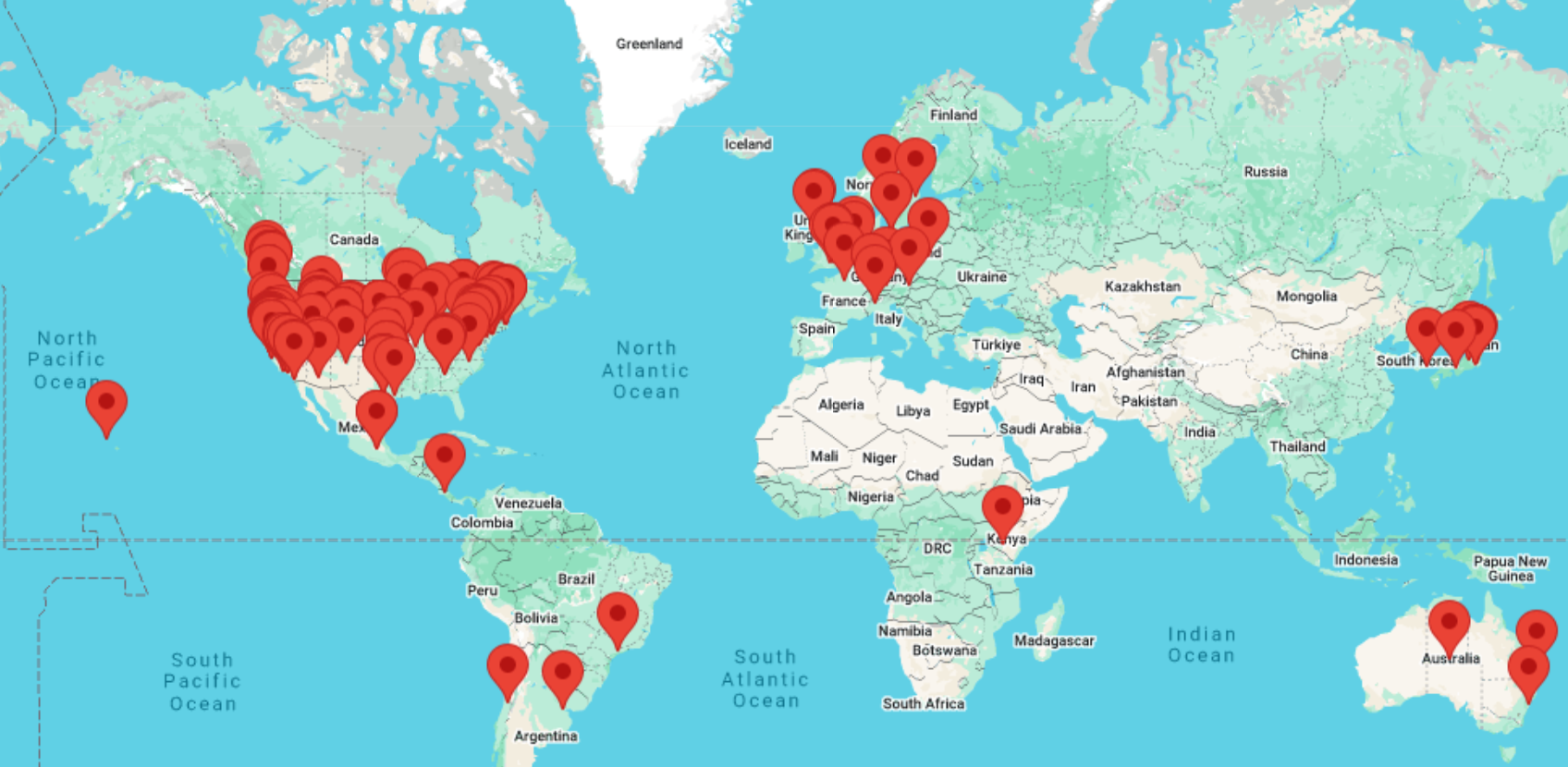
Internationally, Japan continued its strong showing with 12 attendees, primarily from Tokyo (9). The United Kingdom sent 7, Canada 5, Switzerland 4 (all from Zurich), Poland 3, and Germany 3. We saw participation from South Korea and several other countries as well. The attendee map tells the story visually: clusters in North America and Europe, with welcome pins in Asia, South America, Africa, and Australia.
I am glad to see the map filling in beyond the usual corridors, but there is still work to do. Identity challenges are global, and the solutions we build at IIW benefit from hearing voices that face different regulatory environments, infrastructure constraints, and cultural expectations. We continue to support IIW-InspiredTM regional events like DID:UNCONF Africa and DICE to extend the conversation. If you know identity builders in underrepresented regions, point them our way.
One concrete way to help is through the IIW Global Participation Scholarship, which funds travel and registration for attendees from regions that are underrepresented. The scholarship makes a real difference; it brings perspectives into the room that change the quality of the conversation for everyone. If your organization benefits from the work that comes out of IIW, consider sponsoring a scholarship for IIW 43. The identity infrastructure we are building is meant to serve people everywhere; the people building it should reflect that.
Topics and Themes
The agenda at IIW is built fresh each morning. Participants write their session titles on index cards, announce them to the room, and place them on the agenda wall. That emergent structure is one of the things that makes IIW work; the topics reflect what people are actually building, struggling with, and thinking about right now. Here's a recap of what the community brought to the table this time.
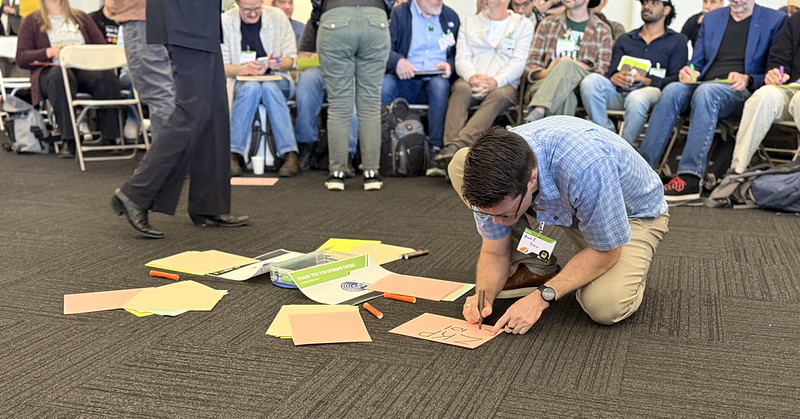
SEDI and the duty of loyalty were prominent throughout the workshop. Sam Smith led sessions on KERI/ACDC bulk issuance for SEDI privacy and on cryptographic foundations, while separate conversations explored SEDI's legal framework, its duty of loyalty provision, and how it connects to protocols like MyTerms. As I wrote in Data Protection Missed the Point; Loyalty Gets It Right, the duty of loyalty shifts the basis for regulation from data to the relationship. That idea had real traction in the room, with people working through what it means for implementation, not just theory.
Agentic identity was everywhere. Sessions covered agent taxonomy (what counts as an agent? ephemeral versus persistent?), OAuth for sub-agents, AI agents and open banking, agent storyboarding, and agentic identity credentials. Drummond Reed introduced the Decentralized Trust Graph and First Person Project. Dick Hardt led an AAuth deep dive, exploring his open protocol that gives agents their own cryptographic identity without pre-registration or shared secrets. The question running through all of these was not whether agents need identity; it was how we build identity systems that let agents act on behalf of people without becoming another layer of administrative intermediation. A Dilithium demo showed server-side user-agents operating at speed, and multiple sessions explored how authorization models need to adapt when the entity presenting a credential is not a human but a piece of software acting with delegated authority.
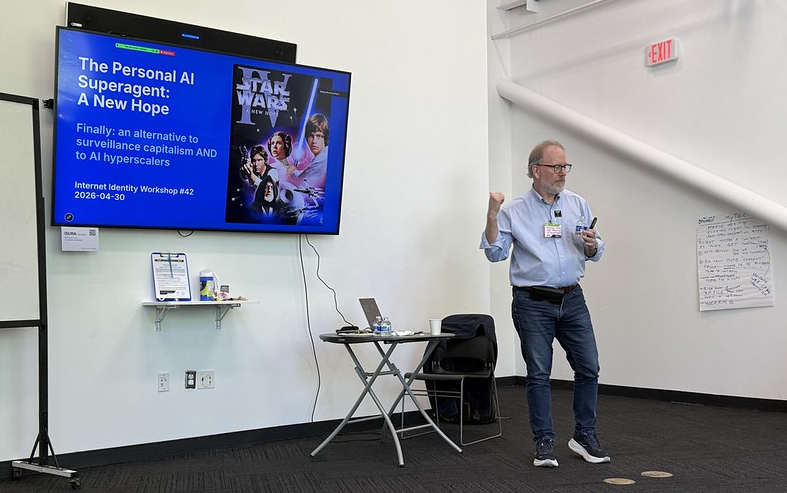
MyTerms, the newly published IEEE 7012 standard, had a strong showing across all three days. Doc Searls led MyTerms 101 and 101.5 sessions, and Iain Henderson ran a session connecting VRM, MyTerms, and fiduciary agents. MyTerms gives individuals a protocol for proposing terms to websites as first parties rather than clicking through adhesion contracts. The connection to SEDI's duty of loyalty—which I explored in a post from VRM Day—was a recurring thread. Together, they start to look like operational infrastructure for digital relationships where people have standing as participants, not just data subjects.
The standards and protocol track was robust. OpenID4VC had sessions covering updates and implementation details, including server-to-server issuance via OpenID4VCI. Aaron Parecki ran OAuth 101 and John Bradley covered FIDO and WebAuthn. The W3C Verifiable Credentials Working Group held a session on its new charter and current work. Frederik Krogsdal Jacobsen ran sessions on formal security verification of specs and on interaction endpoint authorization via first-party apps. Content authenticity also had a visible presence, with sessions on the C2PA standard and the Content Authenticity Working Group (CAWG), plus an originator profile session; as AI-generated content proliferates, provenance is becoming an identity problem whether the identity community planned for it or not. These sessions reflected a community that is past the design and implementation phases and into the details of making things work at scale.
On the cryptographic front, we saw renewed energy around:
- Post-quantum readiness—a Dilithium demo and sessions on cryptographic agility showed the community taking the transition seriously, not just talking about it.
- Zero-knowledge proofs—ZKP 101 sessions, a ZKP age verification demo, and Sam Smith's session on misapplications of bare signatures and ZKPs for non-ephemeral case proofs.
- KERI and GLEIF—Kent Bull ran KERI + did:webs 101 with GLEIF, connecting decentralized key management to real-world organizational identity at scale.
Trust infrastructure surfaced as a theme in its own right. Erica Bjune led a two-part session on trust infrastructure as a public utility. Mike Leahy convened the first Fiduciary Commons session, working from first principles toward law. Joe Andrieu provided a digital fiduciary update. These conversations share a premise: that trust is not just a technical property of a protocol; it is a social and institutional arrangement that needs its own infrastructure. That framing resonates with the broader shift from building identity tools to building identity institutions.
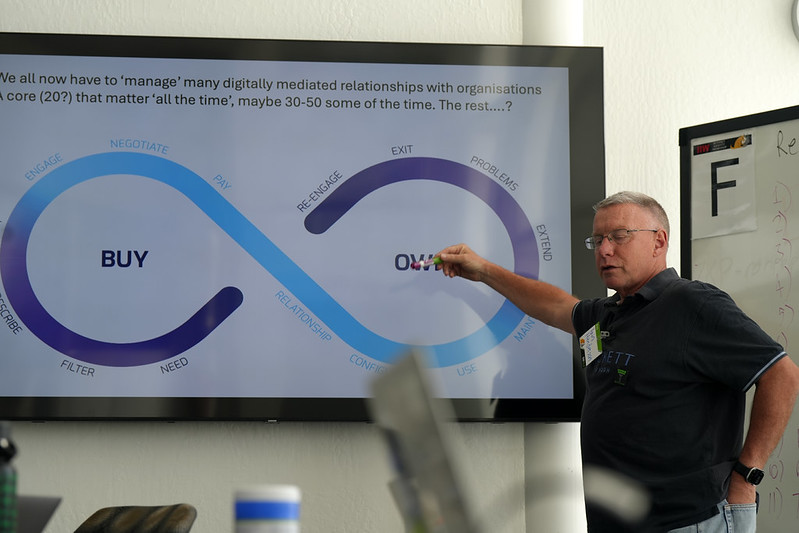
The EUDI wallet drew attention with sessions on the German implementation and on wallet-level authentication and authorization. These sessions brought a European regulatory perspective into the room, grounding abstract wallet discussions in the specifics of what member states are actually building.
There were also sessions looking at identity at a more foundational level. Christopher Allen revisited SSI principles for the next decade in his "SSI 10th!" session. Denny Wong asked why personal identity matters in the era of AI. Eric Welton explored cognitive liberty and captive audiences through a First Amendment lens. Dean Saxe and Eve Maler convened a session on death and the digital estate, something that eventually concerns us all. And Wendy Seltzer led a session on identity and geopolitics, reminding us that the infrastructure we build operates within political systems that have their own ideas about who controls identity, a good counterpoint to the SEDI discussions.
The 101 sessions deserve a mention. IIW has always been a place where newcomers can get grounded, and this time the program included introductions to OAuth, OpenID Connect, FIDO/WebAuthn, ZKPs, SSI, OpenID4VC, authorization, and content authenticity. Steve McCown and Omri Gazitt ran particularly well-attended sessions. These 101 tracks are not filler; they are how the community renews itself and ensures that the deep-dive sessions in later slots have a prepared audience.
Demo Hour
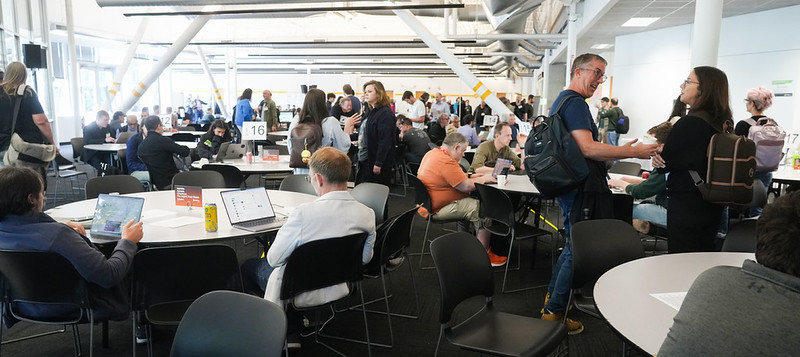
One of IIW's distinctive features is the speed demo hour on Wednesday afternoon. Twenty tables, each with a numbered sign, fill the Grand Hall. Each demonstrator gives a five-minute demo, then the audience rotates to the next table. If you're disciplined, you can see 10 of the 20 demos over the course of an hour. It is loud and seemingly chaotic, but it works. Demo hour is about working code and running systems. You can tell a lot about a community by what it chooses to demo.
This time, the demo tables told a clear story: agents have arrived, and the identity community is building the infrastructure to make them trustworthy. Niki Niyikiza showed Tenuo's attenuating authorization tokens that cryptographically narrow an agent's capabilities at each delegation hop. Dick Hardt demoed AAuth, an open protocol giving agents their own cryptographic identity without pre-registration or shared secrets. Kenta Takahashi and Takayuki Suzuki demonstrated Proof of Human Delegation, using biometrics to prove that an agent acts on behalf of a specific person within their stated intent. Ankit Agarwal showed KYAPay, a protocol for agent authentication and tokenized payments. And Alex Olivier and Atul Tulshibagwale demoed a reference implementation of the OpenID AuthZEN MCP Profile for fine-grained, parameter-level authorization before an MCP server executes a tool. The common thread: agents need identity, authorization, and accountability, and those cannot be afterthoughts bolted on later.
Wallets and credentials showed up in force. Rob De Feo showed an AI agent completing an age-verified purchase and hiring a car through the EUDI Wallet via OpenID4VP. Jarek Sygitowicz and Flora Frend demonstrated practical EUDI implementations using the Digital Credentials API on iOS and Android with fallback to legacy eIDs. Dmitri Zagidulin showed Freewallet, a free, open-source web wallet for DIDs and verifiable credentials. Christopher Allen demoed XIDs, DID-inspired identifiers built on Gordian Envelope that give holders, rather than issuers, control over what gets revealed through selective disclosure and redaction.
Several demos pushed into new territory. Iain Henderson and Jon Udell showed MyKey combined with MyTerms and XMLUI, connecting decentralized identifiers to privacy terms and a semantic UI framework. David Condrey's WritersProof captured cryptographic proof of human authorship by entangling identity, keystrokes, and timing into an unforgeable hash chain. Mahesh Balan showed MyWellWallet, a patient-owned health wallet using local LLMs and FHIR to give people an intelligent view of their health data without sending it to the cloud. And Deb Bucci demoed an execution-time delegation harness that evaluates whether a delegated action still aligns with a person's intent at the moment it is requested. Twenty tables, twenty teams showing things that did not exist a year ago.
Looking Ahead
Because IIW runs on Open Space, every workshop is a fresh expression of where the community actually is. No program committee selects topics months in advance; the people who show up decide what matters that morning. That is what makes each IIW genuinely new. The topics at IIW 42 reflected a community whose conversations were less about whether the architecture is right and more about how to deploy it, govern it, and make it work for people who will not attend an unconference. SEDI's duty of loyalty, MyTerms, agentic identity, post-quantum readiness, the EUDI wallet: these are implementation challenges now, not research topics. The people in the room are doing the implementation.
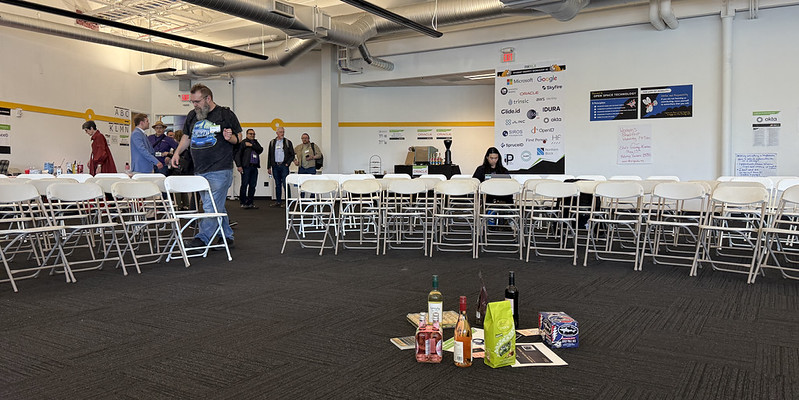
Huge thanks to everyone who convened a session, asked a hard question, showed a demo, or pulled someone into a hallway conversation. That is what makes IIW work, and it has been working for 42 editions now. The book of proceedings will be available soon with session notes, links, and other important details.
Mark your calendars: IIW 43 is November 3–5, 2026, with AIW3 on Friday, November 6. Tickets will be on sale in about a month. Sponsorships are available now. Until then, keep building.
You can check out all of Doc's photos of IIW 42 for a visual report on who, what and when.
Photo Credit: IIW XLII Photos from Doc Searls (CC BY 4.0)