Human in the Loop Control for OpenClaw
Some agent actions are too consequential to leave to policy alone. This post describes a new OpenClaw demo that uses Cedar and a Yubikey to put a human in the loop, binding each approval to the exact action being approved. Because the control lives in the harness rather than the prompt, the agent can't reason its way around it.
Continue reading {Human in the Loop Control for OpenClaw}
Authentication Is Largely Solved. Authorization Isn't.
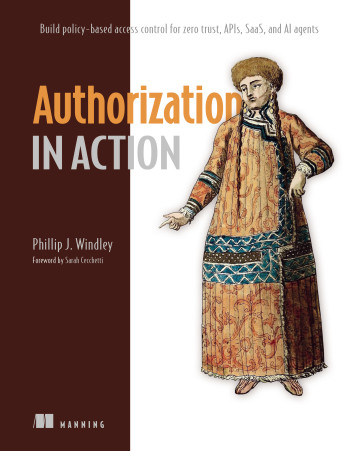
My new book, Authorization in Action, is out from Manning. It's about the question that comes after we know who you are: what are you allowed to do, under what conditions, on whose behalf, and in what context? Authentication is largely a solved problem; authorization is not, and AI agents are about to make that gap impossible to ignore.
Continue reading {Authentication Is Largely Solved. Authorization Isn't.}
The Pressure Behind Identity's Diseconomies of Scale
Eve Maler argues that identity's apparent diseconomies of scale are really about gnarliness, not size. That gnarliness has a shape I drew for chapter 19 of my forthcoming book: the gap between a growing decision surface and the infrastructure meant to govern it. That gap is authorization pressure, and it explains why identity gets harder even when a team does everything right.
Continue reading {The Pressure Behind Identity's Diseconomies of Scale}
The Shape of Context in Agentic Authorization
In agentic systems, the principal, action, and resource are often unknown until the moment an agent acts, and the context that governs the decision arrives as a flood of signals from many sources. This post looks at how that context takes shape, where each signal is actually consumed, and why a non-directed world of agents still needs decisions that humans can inspect and predict.
Continue reading {The Shape of Context in Agentic Authorization}
AI Integration in Picos Starts with Events
Picos already have persistent identity, owned state, and an event-driven architecture—exactly the properties that make a good substrate for AI agents. The integration path starts with a simple webhook and leads somewhere much more interesting: a world where AI works for you, reasoning over data that is stored in your picos rather than on someone else’s platform.
Continue reading {AI Integration in Picos Starts with Events}
It's Not Just What Agents Can Do...It's When They Can Do It!
Agents don't just perform actions; they execute plans where the safety of each step depends on what has already happened. That makes sequencing an authorization problem. This post explores how policy, delegation data, and multi-signature approval can govern the order in which agents receive authority, not just the scope of it.
Continue reading {It's Not Just What Agents Can Do...It's When They Can Do It!}
Agentic AI and Dynamic Authorization: A Series Recap
I've been exploring how policy, delegation, and continuous authorization can make agentic AI systems useful without making them ungovernable. This post ties together nine essays that trace that journey from foundational ideas to practical patterns.
Continue reading {Agentic AI and Dynamic Authorization: A Series Recap}
Cross-Domain Delegation in a Society of Agents
Cross-domain delegation requires more than transferring a credential. In a society of agents, policies define boundaries, promises communicate intent derived from those policies, credentials carry delegated authority, and reputation allows trust to emerge through repeated interactions.
Continue reading {Cross-Domain Delegation in a Society of Agents}
Delegation as Data: Applying Cedar Policies to OpenClaw Subagents
Intra-domain delegation enables an agent to grant constrained authority to subagents without expanding the system’s trust boundary. In the OpenClaw + Cedar demo, delegation is modeled as data and enforced by a stable policy set, preserving policy integrity while allowing dynamic scoping of power.
Continue reading {Delegation as Data: Applying Cedar Policies to OpenClaw Subagents}
Childproofing the Control Plane: Using Cedar to Build Frontal Lobes for Agentic Systems
Connecting an agent like OpenClaw to Home Assistant can make home automation more adaptive and intelligent, but it also introduces real risks if authority is not clearly bounded. By externalizing decision logic into deterministic Cedar policies, we can create governed autonomy that allows agents to act usefully while preventing them from crossing safety, security, and privacy boundaries.
Continue reading {Childproofing the Control Plane: Using Cedar to Build Frontal Lobes for Agentic Systems}
Beyond Denial: Using Policy Constraints to Guide OpenClaw Planning
OpenClaw agents plan, adapt, and act over time, so authorization that functions merely as a reactive gate isn't the best architecture. In this post, I show how integrating Cedar's query constraints and Typed Partial Evaluation lets OpenClaw discover what is allowed before acting. The result is an agent that plans within policy-defined boundaries while still enforcing every concrete action at runtime.
Continue reading {Beyond Denial: Using Policy Constraints to Guide OpenClaw Planning}
A Policy-Aware Agent Loop with Cedar and OpenClaw
This article demonstrates how to move authorization inside the agent loop by inserting a Cedar-backed policy decision point into OpenClaw, so that every tool invocation is evaluated at runtime. Instead of acting as a one-time gate, authorization becomes a continuous feedback signal that guides replanning and enforces Zero Trust principles for agentic systems.
Continue reading {A Policy-Aware Agent Loop with Cedar and OpenClaw}
Why Authorization Is the Hard Problem in Agentic AI
Agentic AI systems expose the limits of static authorization models, which assume permissions can be decided once and remain valid over time. As agents plan, act, and replan, authorization must become a continuous feedback signal that constrains behavior at each step rather than a one-time gate. Dynamic, policy-based authorization enables delegation to be enforced through purpose, scope, conditions, and duration, turning denial into a productive signal that guides replanning instead of a terminal failure.
Continue reading {Why Authorization Is the Hard Problem in Agentic AI}

Explore Technometria
Popular Topics
- Actor Model
- Agentic AI
- Authentication
- Authorization
- Blogging
- Decentralization
- Event Programming
- Identity
- IIW
- Internet of Things
- IT Conversations
- Javascript
- KRL
- Kynetx
- Picos
- Programming
- Programming Languages
- Reactive Programming
- Reputation
- Sovrin
- Startups
You Might Also Enjoy
- Self-Sovereign Identity References
- Best Food Blog on the Planet
- Live Web Whitepapers
- My Slides
- My Videos
- CTO Breakfast
- Essays
- CIO Whitepapers
My Books