Summary
Picos already have persistent identity, owned state, and an event-driven architecture—exactly the properties that make a good substrate for AI agents. The integration path starts with a simple webhook and leads somewhere much more interesting: a world where AI works for you, reasoning over data that is stored in your picos rather than on someone else’s platform.
When I think about integrating AI into pico-based systems, the temptation is to imagine some deep architectural rework—a new runtime, a new protocol, some fundamental change to how rulesets execute. But I think the right starting point is already there in the architecture: events. Picos already send and receive events. Claude routines already listen for triggers and respond with actions. Connecting them is not a research problem; it is an integration problem, and a shallow one at that.
The simplest version looks like this: a pico fires an event, a Claude routine receives it via webhook, does some reasoning, and posts a response event back to the pico's event channel. The pico's ruleset handles the response the same way it handles any other event: routing it, acting on it, updating state. Nothing in this picture requires changes to the pico engine or the Claude API. Both sides speak events; the webhook is just the seam between them.
I saw this pattern clearly when I was building Fuse, the connected-car application built on picos. Fuse picos held the car's data and fired events when interesting things happened: location changes, diagnostic codes, ignition on and off. The missing piece, looking back, was anything that could reason over those events rather than just route them. An AI routine that receives a pico event carrying a diagnostic code and responds with an interpretation—or a question—is exactly the kind of capability Fuse needed and couldn't easily have in 2014. Fuse sent notifications, but bare notifications are not very useful to most people. An AI layer that enriches a location event with context ("you're near the dealership where your recall service is overdue") or translates a diagnostic code into plain language and a recommendation would have made Fuse dramatically more useful to drivers.
Project Neck Pain showed something similar from a different angle. That project used picos to hold personal health data: appointments, sensor readings, notes. The pico owned the data; it didn't live in some third-party health app's database. But ownership without intelligence is just storage. The interesting question was always: what should happen next? We built rules that would automate some of the drudgery of dealing with the healthcare system. But, it proved to be too brittle. AI changes that completely. An AI routine that receives an event—a symptom log, a missed appointment, a change in a sensor trend—and responds with an inference is not replacing the pico's role. It is extending it. The pico remains the locus of identity and state; the AI contributes reasoning that the ruleset alone can't do.
This suggests a natural progression for AI integration in pico systems.
-
The first step is the webhook pattern I described: AI as an external actor that exchanges events with the pico. This just uses the
http:post()to call a URL. - The second step is tighter: rather than an external routine, a KRL action sends a request to Claude with a callback event URL, and a separate rule handles the response when it arrives asynchronously. This fits how picos actually work—rules fire in response to events, and Claude's processing times make a synchronous call inside a rule impractical. The callback event is the right model; Claude becomes a capability the ruleset can invoke, not a separate system to coordinate with by hand.
- The third step is the one I find most architecturally interesting. At this stage, Claude uses pico query endpoints as tools to read and write persistent state across sessions. The pico is the memory. This matters because most AI memory schemes are ad hoc, using a database or even a Markdown file for memory. Picos already have the right structure: named, persistent, owned by a specific identity.
- The fourth step follows from the third. If Claude holds a longer-running task and the pico holds the relevant state, then Claude can fire events into the pico graph to make things happen—not just to return data to the ruleset, but to orchestrate behavior using the pico's event channels the way a person would.
What makes this progression coherent is that picos already have the properties that make for an interesting AI integration.
- They have persistent identity—each pico is a specific thing with a stable address.
- They have owned state—the data inside a pico belongs to the pico, not to a platform that might revoke access or change terms.
- And they are event-driven—which is exactly the interface AI systems are designed to plug into.
I've argued for years that picos are the right substrate for building systems where people and things control their own data. Adding AI reasoning to that substrate doesn't change the argument; it strengthens it. An AI that reasons on your behalf, over your data, stored in your picos, is a fundamentally different thing from an AI that reasons on your behalf using data held by someone else. The first is an agent working for you. The second is an administrative intermediary with a language model grafted on.
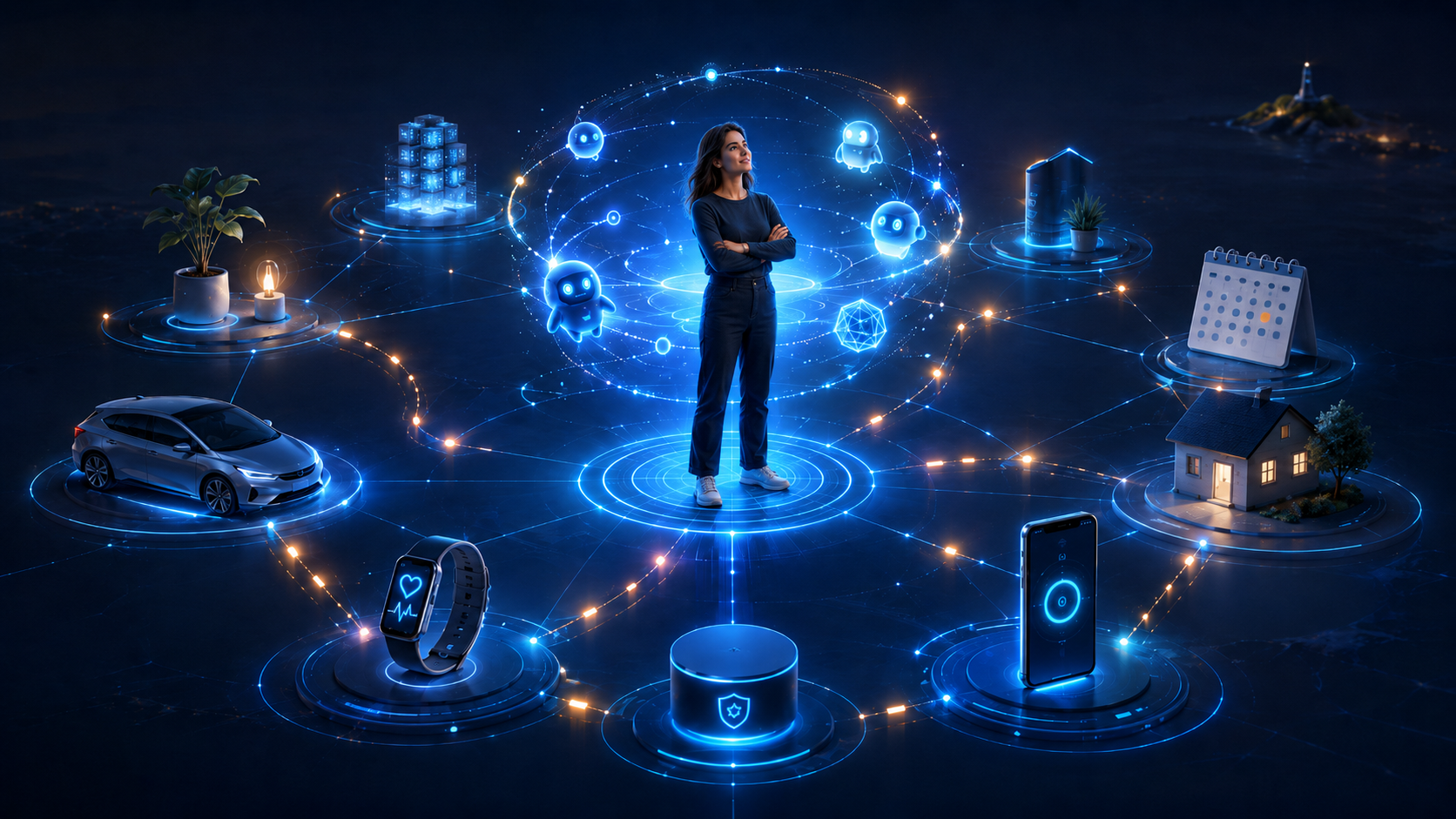
Picos form natural hierarchies. A car pico holds what the car knows; the household pico that owns it can query across all its children—car, health devices, calendar—and give an AI a cross-domain view that no flat memory store provides naturally. Each pico in the hierarchy can have its own AI context and reasoning scope, and parent picos can aggregate across children. That hierarchy also encodes privacy boundaries: an AI reasoning on behalf of the household can traverse the graph with appropriate permissions, but no external system can simply reach in. The ownership structure is not metadata bolted on; it is the architecture.
The webhook integration is worth building right now because it establishes the semantics that the deeper integrations depend on. Which events are meaningful enough to route to an AI? What does a useful response event look like? How does the ruleset act on it? Answering those questions with a simple prototype clarifies the architecture far better than designing it on paper. That is how picos got to where they are today, through real use cases that forced the design into focus. The AI integration will be no different.
Photo Credit: Owned AI Agents via Picos from DALL-E (public domain)