Summary
IIW XLIII brought 265 people to the Computer History Museum in Mountain View for 147 sessions on identity, agents, and the infrastructure that connects them to the people they serve. Both the agenda wall and the demo tables made the throughline plain: the community has moved past giving agents identity and on to holding delegated authority accountable. Personal agents, first person trust, SEDI, and credential certification rounded out the agenda.
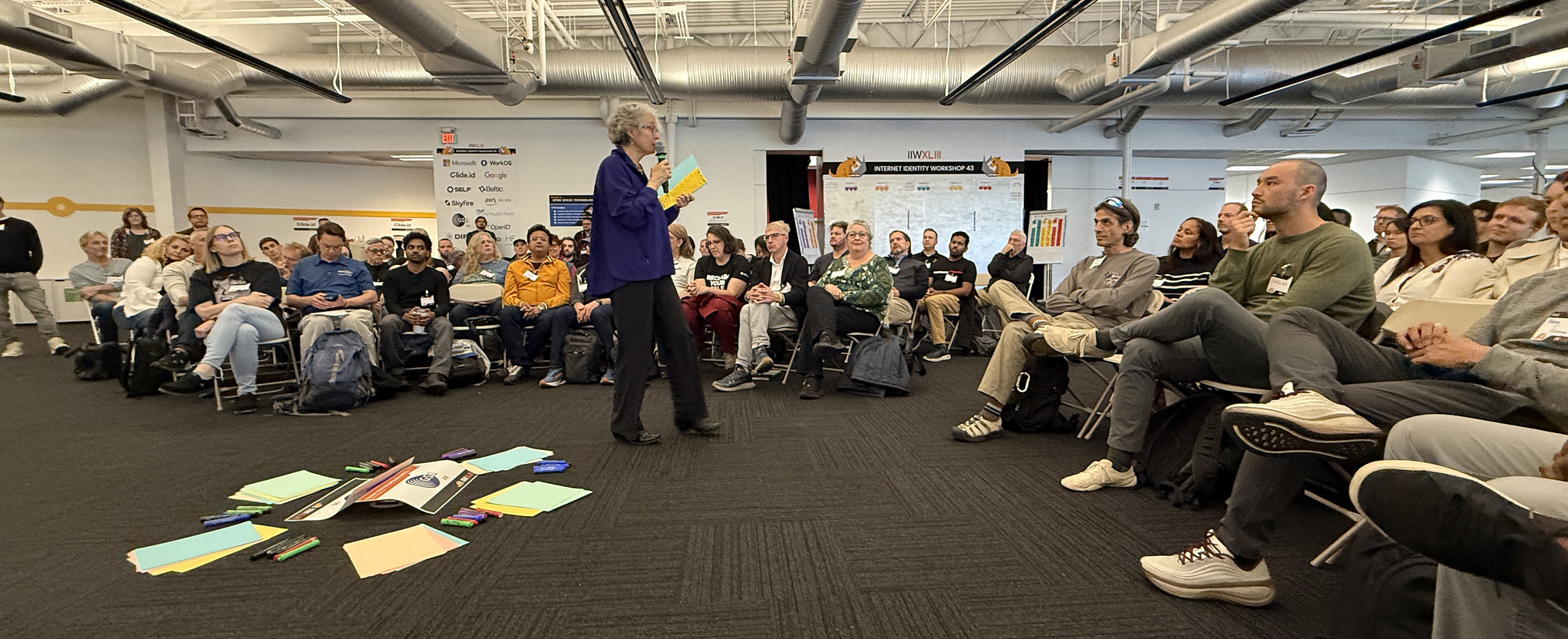
The Internet Identity Workshop met for the 43rd time at the Computer History Museum in Mountain View, California, November 3–5, 2026. As always, the Open Space unconference format let the agenda emerge from the people in the room each morning. Nobody picked the topics months in advance; the people who showed up decided what mattered, convened sessions on it, and argued it through.
We also held the third Agentic Internet Workshop (AIW3) on Friday, November 6, the day after IIW. It used the same unconference format, but with a broader scope. Identity for agents gets plenty of attention at IIW, and we expect that; AIW takes on agents more generally, including harnesses, protocols, and the rest of what it takes to build an agentic internet that works for people.
Attendance
IIW 43 brought together 265 participants, a little below the 287 we saw at both IIW 41 and IIW 42. Attendance has now held in a narrow band for more than a year. That steadiness tells me something about the community; people come to IIW to work on problems, not to chase whatever is hot this quarter. Those 265 people came in on 243 orders, so a good number of organizations sent small teams rather than a single representative.
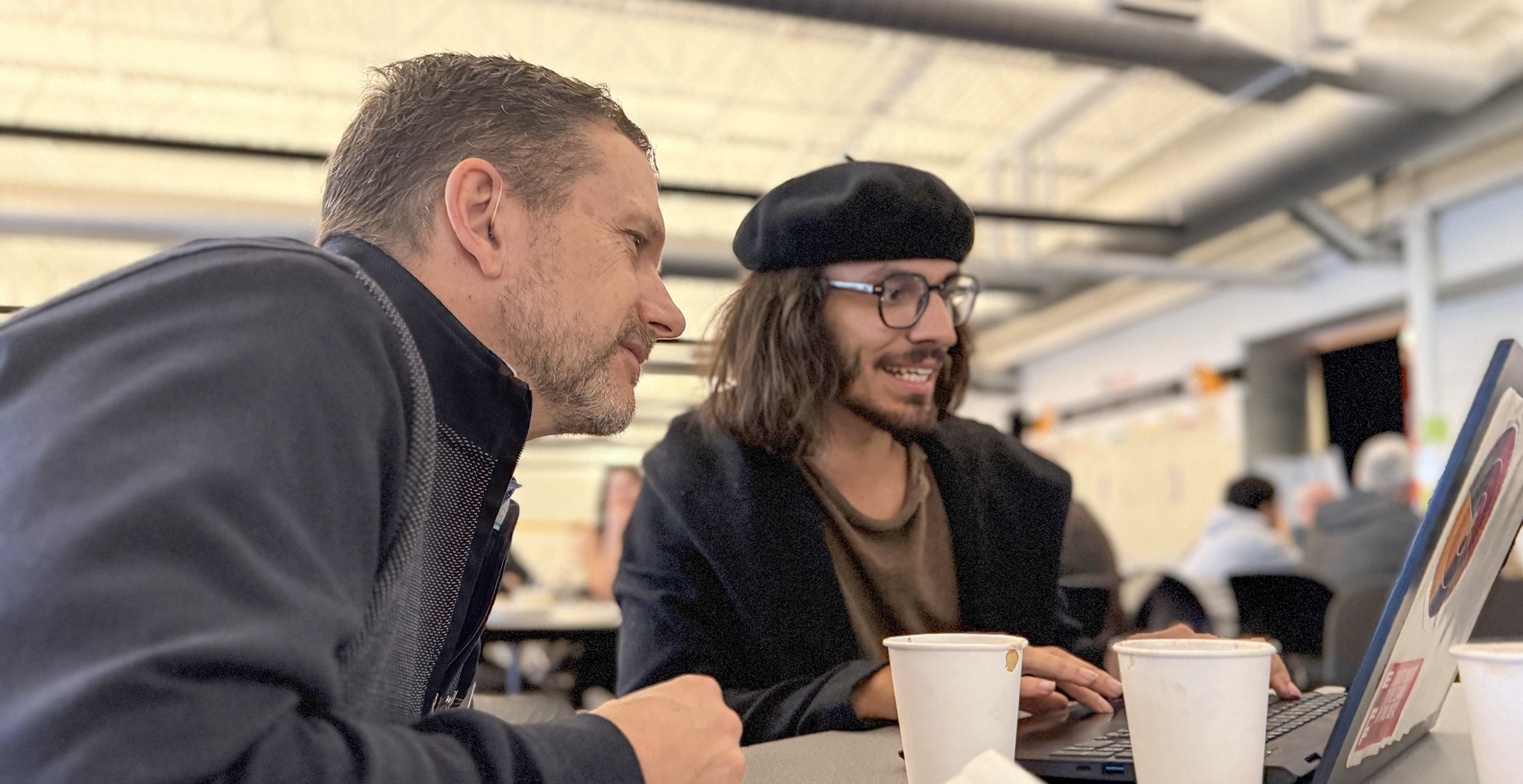
The sessions are the visible part of IIW, but the hallway track is where much of the work happens. People finish a session, keep talking at a table outside, and pull in someone who was in a different session an hour earlier. Meals are included for exactly that reason; they keep the conversations going instead of scattering everyone to restaurants at noon.
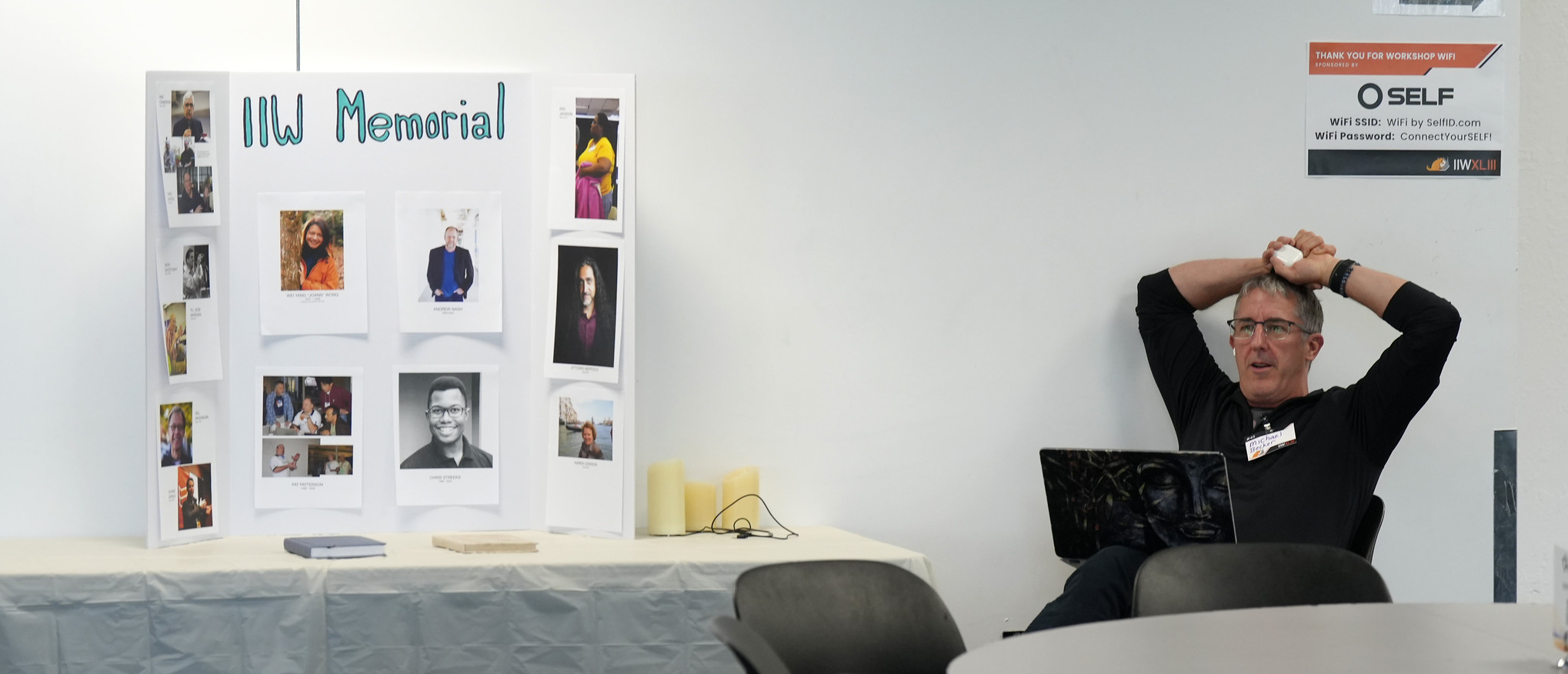
As at past workshops, the IIW Memorial table had photos of members of this community who have died. Many of them sat in the circle, convened sessions, and helped shape the ideas we're still working on. IIW has always been a community as much as a workshop, and it was good to have a place to remember them.
Geographic Diversity
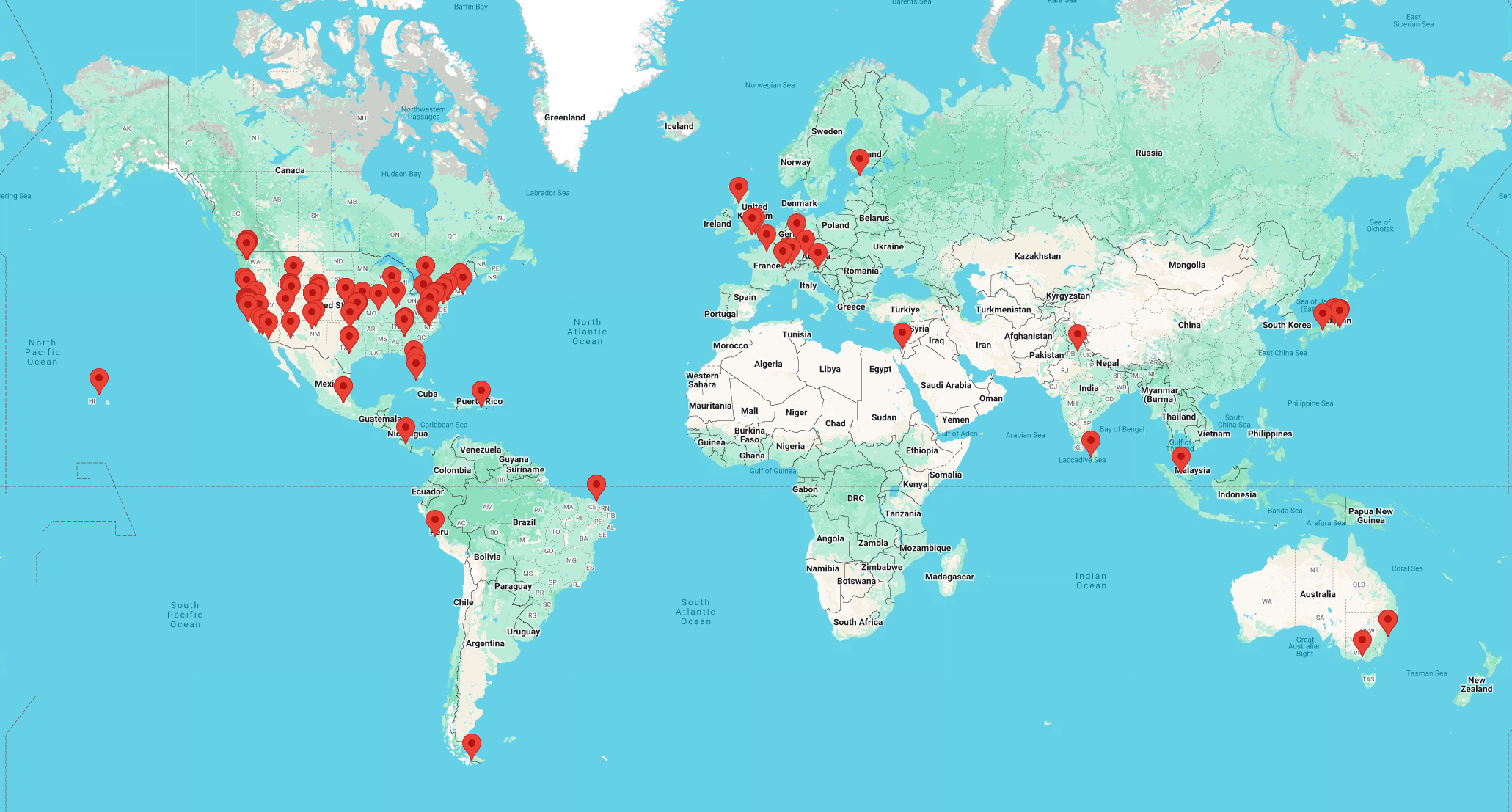
The United States accounted for 212 of 265 attendees, and California for 115 of those. The Bay Area carried most of the California number: San Francisco (23), San Jose (14), Oakland (8), Mountain View (8), Santa Clara (4), and Palo Alto (4). Utah sent 16, the second-largest state delegation, with 7 from Salt Lake City. Washington followed with 14, mostly from Seattle. Georgia sent 9, seven of them from Lawrenceville, and Texas and Massachusetts each sent 8.
Internationally, Japan led again with 8 attendees, 5 of them from Tokyo. Germany doubled its spring showing to 6, Switzerland sent 5, Canada 5, and the United Kingdom 4. Mexico and Australia each sent 3, and the United Arab Emirates, Spain, and Brazil 2 apiece. The map adds single pins across Asia, the Middle East, Central America, and South America, all the way to Patagonia.
The map also shows what's missing. Africa had no pins this time, and Europe's presence, while better than last fall, is still thin given how much wallet and credential work is happening there. Identity problems look different under different regulatory regimes, infrastructure constraints, and cultural expectations, and the conversation at IIW is better when those differences are in the room. We continue to support IIW-InspiredTM regional events like DID:UNCONF Africa and DICE, and the IIW Global Participation Scholarship funds travel and registration for people from underrepresented regions. If your organization benefits from the work that comes out of IIW, consider sponsoring a scholarship for IIW 44.
Topics and Themes
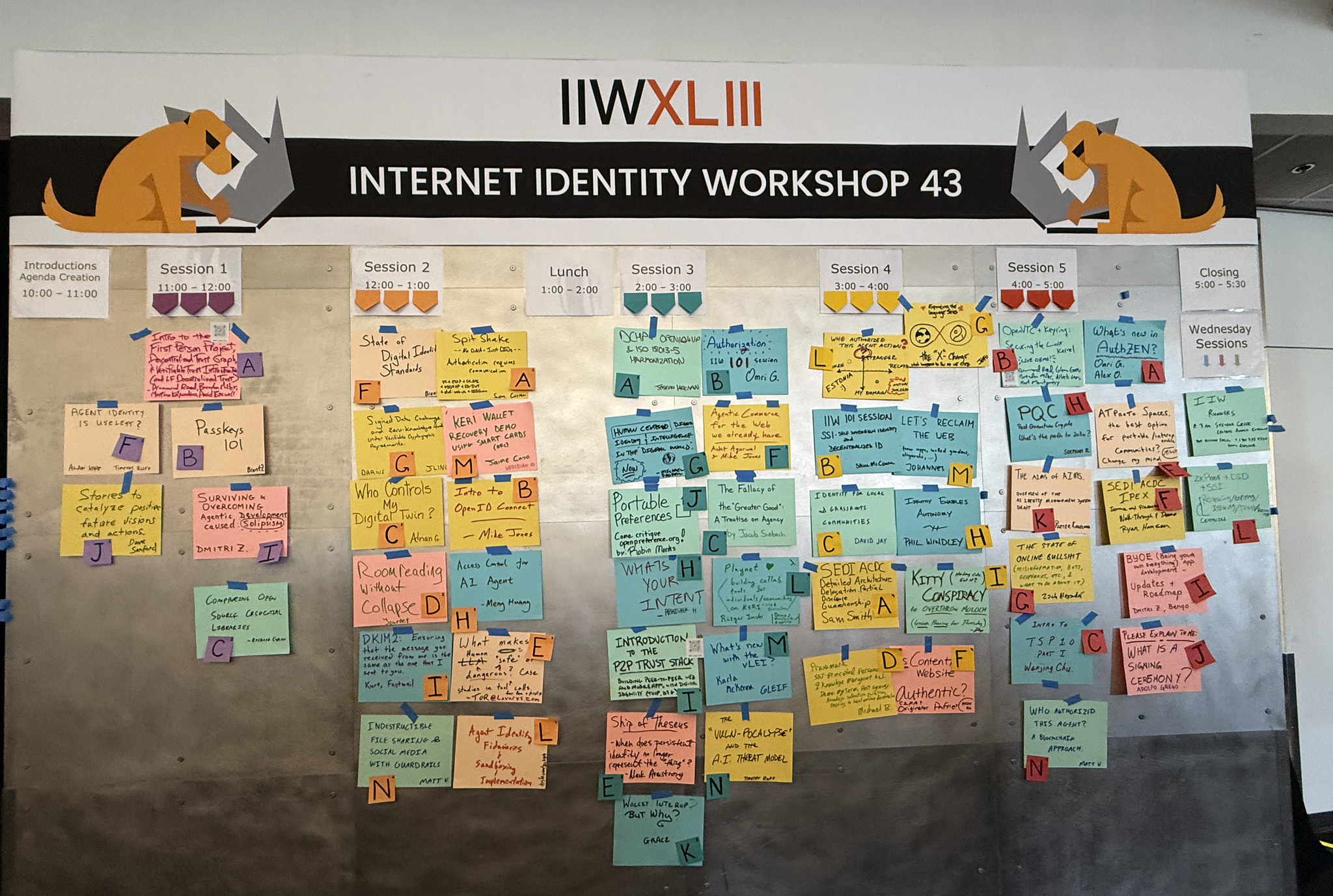
The agenda at IIW is built fresh each morning. Participants write session titles on cards, announce them to the circle, and post them on the agenda wall. That emergent structure is why the agenda is a good snapshot of where the community actually is: what people are building, what's stuck, and what they want help thinking through. This time the community called 147 sessions over fifteen slots, including a few repeated by popular demand.
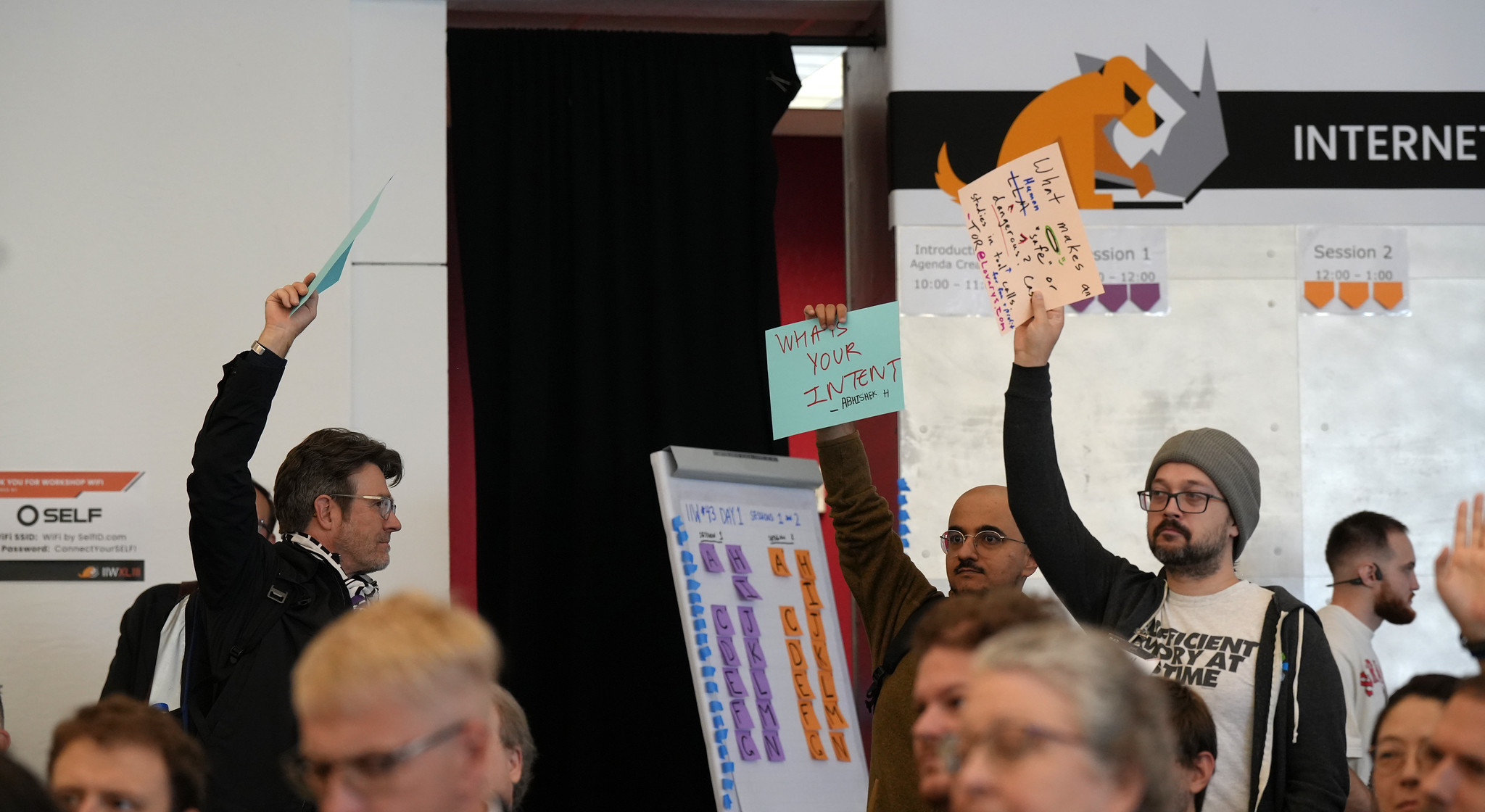
Agent authorization drew more sessions than any other topic, and two titles framed it well. On Tuesday morning, Alan Karp and Timothy Ruff asked whether agent identity is useless; on Thursday, Timothy convened "Gate the action, not the actor." I read those titles as a correction rather than a rejection; knowing who an agent is doesn't tell you whether a particular action is one its person authorized. Anton Sokolov pressed the same point in "Who Authorized the Agent Action?" and in a second session explained why Estonia said no to ID codes for AI agents. Abhishek Hingnikar asked "What's Your Intent?" and Matt Vogel proposed an intent layer that standardizes the why behind software.
The protocol work behind that argument was everywhere. Omri Gazitt and Alex Olivier covered what's new in AuthZEN, and Omri followed with a session on agent authorization using OAuth and AuthZEN together. Karl McGuinness presented mission-bound authorization for OAuth, Dick Hardt ran AAuth 101, Tim Cappalli and Arnar Birgisson discussed VALET, a platform-mediated OAuth for agents, and Yaroslav Rosomakho covered human-in-the-loop step-up authorization. Adolfo Grego proposed ARIA, an agent registry for identity and authorization, and Pieter Kasselman walked through the draft AI identity management system (AIMS). Lisa Dusseault asked whether we should destroy all API keys or make more of them. At the formal end, Conner Swan showed zero-knowledge proofs of client-side policy decisions and Rohit Khare brought theorem provers to authorization with AutoFormalize.
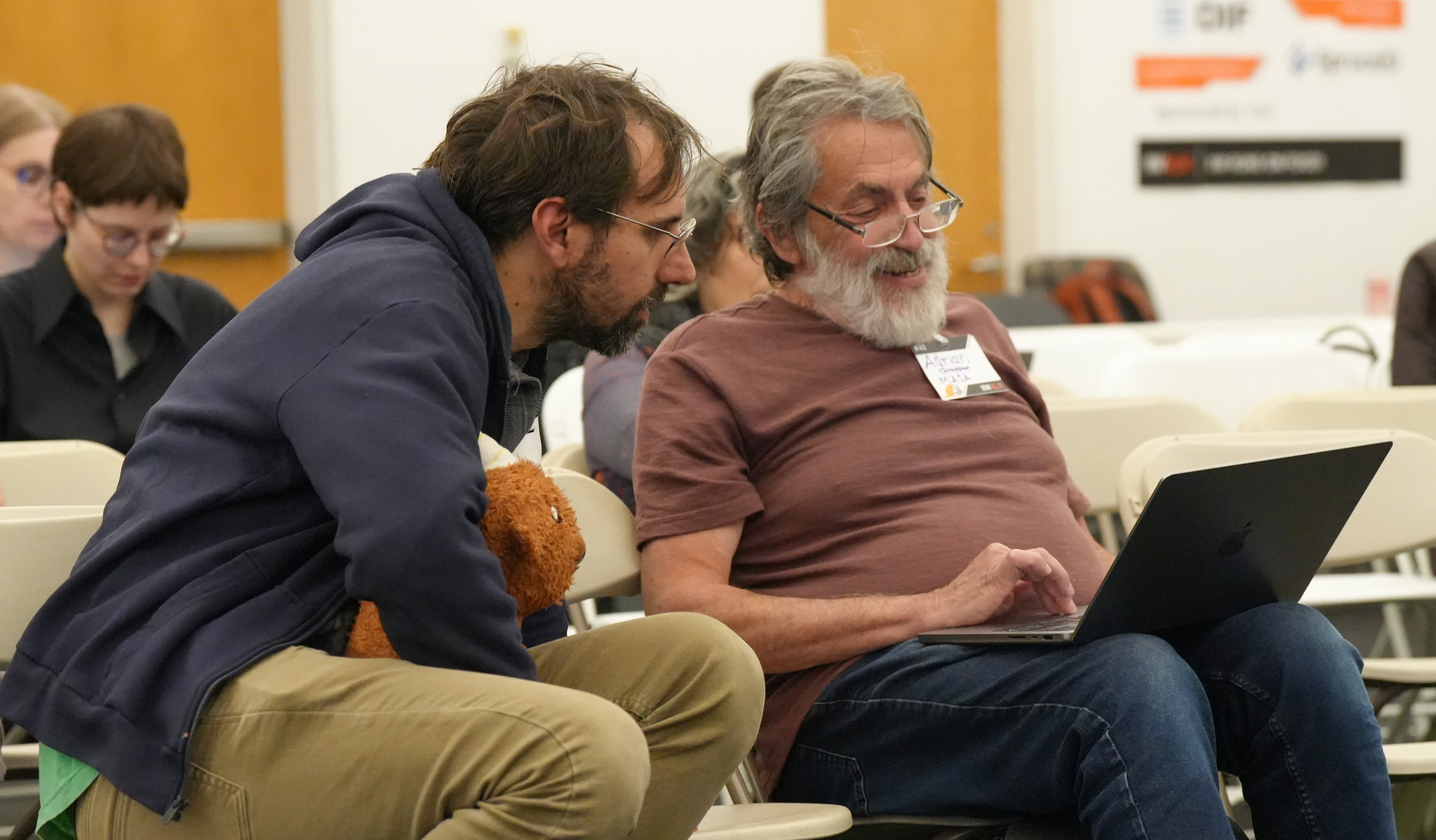
Personal agents and fiduciary AI formed a second cluster. Elliot Noss argued that personal agents are the Trojan horse SSI has been waiting for, then followed up with a DID and VC implementation method for open personal agents. Adrian Gropper asked who controls my digital twin, and Drummond Reed, Beth Porter, and Brendan Miller connected portable memory, digital twins, the Human Context Protocol, and fiduciary AI. Robin Monks asked people to critique openpreference.org, and Rohit Khare asked where we should keep our data portability exports so our agents can share them sensibly. Doc Searls brought MyTerms to work and, with Adrian, made the case that user communities will displace platforms. An agent that works for you needs your context, your preferences, and your terms. The question running through these sessions is who holds them.
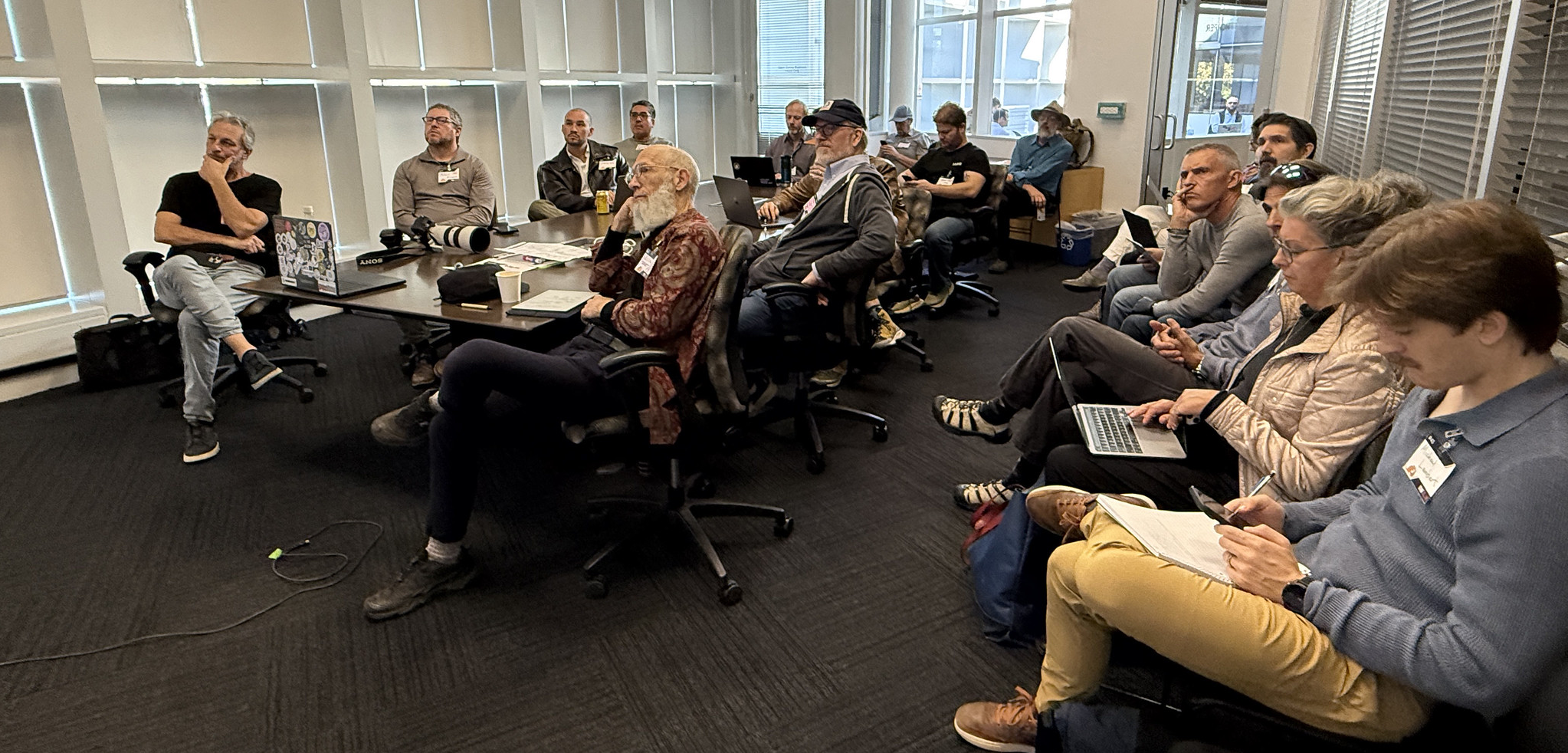
First person trust and community infrastructure had a strong showing. Drummond Reed opened the first slot on Tuesday with an introduction to the First Person Project. Wenjing Chu ran two sessions on TSP 1.0, and the Trust Stackers team (Erika Bjune, Shannon Bailey, and Martina Kolpondinos) introduced the P2P Trust Stack and then walked people through building apps on it. The OpenVTC and Keyring team showed how they're securing Linux kernel contributions, first as a live demo and then hands-on, while David Boswell and Mitch T. showed how to run an OpenVTC community on a Raspberry Pi. Brendan Miller and Drummond closed Thursday with a working session on trust task interoperability.
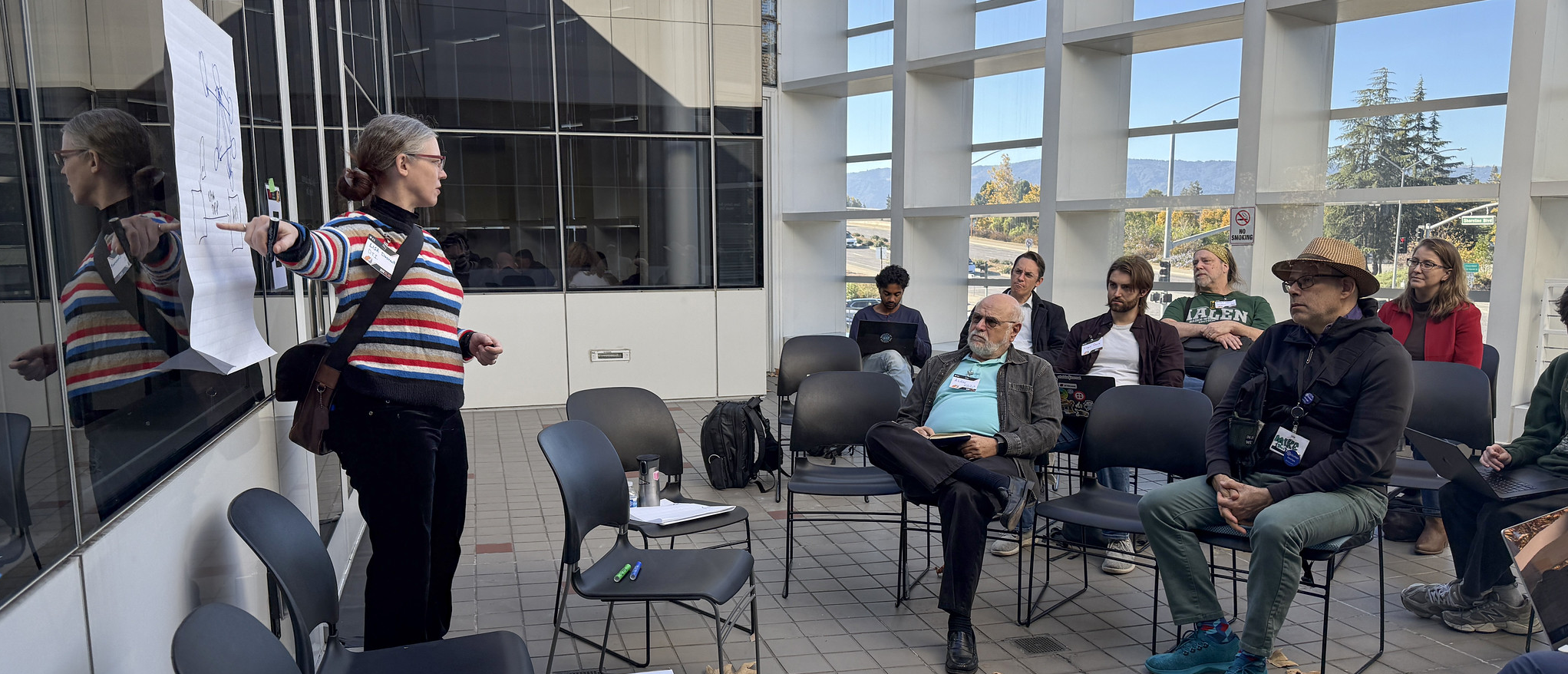
That work extended to communities and the social web. David Jay convened a session on identity for local and grassroots communities, and Brent Shambaugh talked about local-first, globally coordinated hackerspaces. Tibet Sprague invited people to change his mind about AT Proto Spaces as the best option for portable communities, and Aaron Goldman asked "AtProto: Are We Distributed Yet?" Johannes Ernst asked us to reclaim the web, Ben Goering covered Civic.Social and ActivityPub, and Dmitri Zagidulin ran a cross-community interop clinic. These sessions share a premise I agree with: identity is built in relationships and communities, so the infrastructure for it has to work at community scale and not only inside platforms.
SEDI and KERI continued as a major thread. Sam Smith laid out the detailed SEDI architecture with ACDCs, covering delegation, partial disclosure, and guardianship, and Ryan Hansen walked through IPEX with a demo, returning on Thursday for selective and nested partial disclosure. I convened a session on SEDI wallet architecture, and Steve McCown talked about identity's insecurities and how Utah's SEDI and KERI address them. Kent Bull gave his 2026 update on did:webs, Karla McKenna covered what's new with the vLEI, and Esteban Garcia described integrity monitoring for the vLEI ecosystem. Roberto Morano showed KERI and ACDCs acting as an OpenID Connect identity provider with the Veridian wallet, and Jaime Caso demonstrated KERI wallet recovery with smart cards.
A smaller but pointed thread treated AI as a security threat to identity infrastructure. Timothy Ruff convened two sessions on the "VULN-pocalypse," the prospect of AI finding vulnerabilities faster than anyone can patch them, and how SSI principles and protocols help defend against it. Sam Smith argued that KERI and ACDC give us identity systems resilient to AI-driven attacks, and Stephan Baur mapped the path to post-quantum cryptography by 2030. If AI makes attacks cheaper, the cost of weak key management goes up for everyone who depends on it.
The credentials and standards track was focused on making things interoperable and trustworthy in practice:
- Certification—Joseph Heenan on testing and certifying wallets, issuers, and verifiers, and Tim Cappalli on FIDO verifier IDs and wallet certification.
- Harmonization—Joseph Heenan on aligning the Digital Credentials API, OpenID4VP, and ISO 18013-5.
- Comparison—Richard Esplin on open source credential libraries, and Naohiro Fujie and Shigeya Suzuki on the cost, performance, and security of SD-JWT, mdoc, and the W3C VC data model.
- Trust roots and status—Toby Weir-Jones on how each new credential system bootstraps its trust list and on OCSP outside the Web PKI, and Dave Chang on what apps need to know about credential status.
- Privacy and binding—Dan Yamamoto on using ZKPs to stop device-bound passkeys from leaking trackable data, and Takayuki Sadahiro asking whether holder binding is enough.
Brent Zundel's session on the state of digital identity standards gave newcomers a map of all that, and Grace Rachmany asked the useful question of why wallet interoperability matters at all. Certification sessions are a good sign. They mean enough implementations exist that people need to know which ones actually conform.
Content authenticity kept its place on the agenda. Michiko Kuriyama convened or co-convened three sessions on Originator Profile and C2PA, including a deep dive with Shigeya Suzuki, and Zach Alexander and Stefano De Vuono took on online misinformation directly with a session on distributed fact checking and a demo of Almnac. As AI-generated content grows, knowing who stands behind a piece of content is an identity problem.
Finally, IIW still makes room for stepping back. Brent Zundel, Drummond Reed, Timothy Ruff, Richard Esplin, and other Evernym alumni looked back at Evernym and how their perspectives on digital identity have changed since, and Christopher Allen gave a progress report revisiting SSI. Mark Armstrong twice took up the Ship of Theseus question of when a persistent identifier stops representing the thing it names, and Jacob Siebach offered a treatise on agency. Sam Curren argued that authentication requires communication, Takashi Kaneko asked what happens to credentials when the holder is no longer available, Dave Sanford asked whether we can own and control our personal devices, and Paul Lovejoy considered proof of personhood as monetary policy. I convened a session arguing that identity enables autonomy, and Junius Ho asked people to imagine IIW in 2036. The 101 sessions did their usual work too: Brent Zundel on passkeys, Mike Jones on OpenID Connect, Omri Gazitt on authorization, and Steve McCown on SSI. These are the sessions that keep the technical work tied to what it's for, and they're how the community brings new people into the conversation.
Demo Hour
Wednesday afternoon brought the speed demo hour. Twenty numbered tables fill the Grand Hall, each demonstrator gives a five-minute demo, and the audience rotates to the next table. If you're disciplined, you can see 10 of the 20 over the hour. It's loud and looks chaotic, but it works, and it puts running systems in front of people instead of slides. You can tell a lot about a community by what it chooses to demo.
The demo tables told the same story as the agenda wall. Last time, at IIW 42, much of the work was still about giving agents an identity and tying it to a person; this time most of the demos took that as given and focused on what happens when an agent acts. Once an agent has an identity, how do you know a particular action falls within what its person authorized, and how do you take that authority back? Anton Sokolov's AEP Sandbox from the Tyche Institute made the point most sharply. An agent signs an action its mandate doesn't cover; every signature checks out, and the verifier refuses the action anyway, with a reason code. A valid signature tells you who acted. It doesn't tell you whether they were allowed to.
Much of the room was working on that second question. Brian Best of Vouched showed an agent placing an order, running into spending and product limits, and getting blocked after the person revoked its permission. Dick Hardt demoed AAuth connecting to arbitrary resources with call chaining and cascading revocation. Janak Amarasena used ThunderID to show how a service can register an agent it doesn't control, give it its own credentials, delegate access, and revoke it. Rich Schaefer and Ian Forester showed agents++, an open-source library that gives each agent a DID, binds it to the authorizing human with a verifiable credential, enforces scope at the database query layer, and writes a tamper-evident audit trail. Sean MacGuire's xChk treats agents like cars, with license plates for registered owners and a passkey approval, photo included, when an agent exceeds its limits.
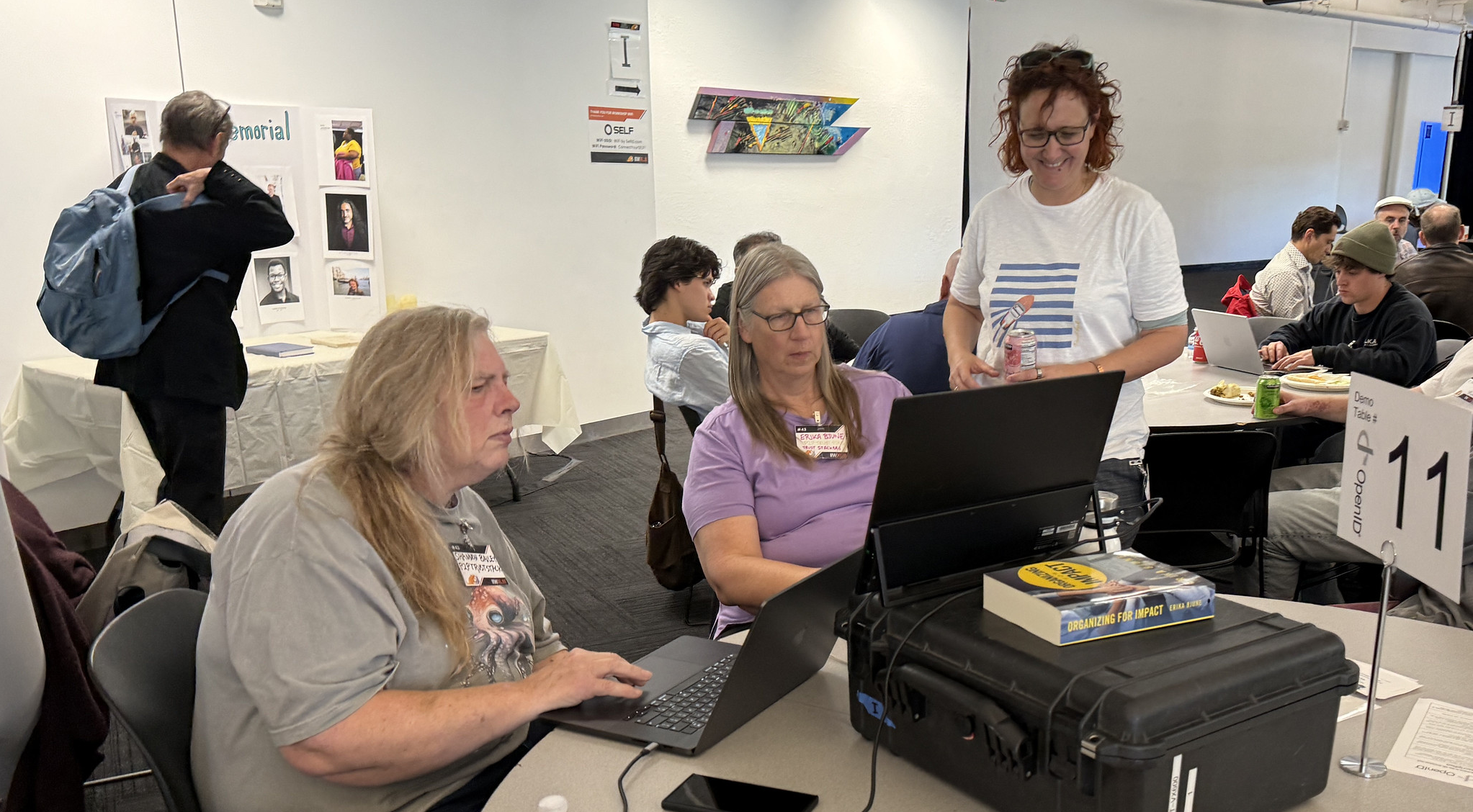
Other demos worked on who stands behind an agent and what rules it follows. Elliot Noss showed Groundmark, which anchors an agent's key in DNS and adds an independent attestation of who stands behind it. Ankit Agarwal returned with KYAPay, extending Know Your Agent to tokenized payments. Mike Schwartz of Gluu authored and released a Cedar policy store in the proposed AuthZEN format, then traced an authorization decision back to the exact policy release that produced it. Adrian Gropper's MAIA lets an AI help a person adapt community-suggested policies to their own context while GNAP enforces them deterministically. And Debbie Bucci asked what it would take for a robot to be allowed to talk to a child; her demo used AAuth to carry a parent's approval into the permission decision, and withdrawing that approval stopped the robot.
Not everything was about agents. Mahesh Balan was back with MyWellWallet, a patient-owned health wallet that uses FHIR, MCP, and a local LLM so health data never leaves the device. Tor Hagemann's Lovarys Sync scans for what an AI company knows about you and who it's sharing that with. Marina Piller showed OTIS Labs' work on helping people keep identity, context, and authority as they interact with intelligent systems. Erika Bjune, Shannon Bailey, and Martina Kolpondinos of Trust Stackers connected peers over TSP, exchanged verifiable relationship credentials, and stood up a community with signed membership. Matthew Vogel showed a social video app on YadaCoin that uses verifiable credentials for privacy-preserving age verification.
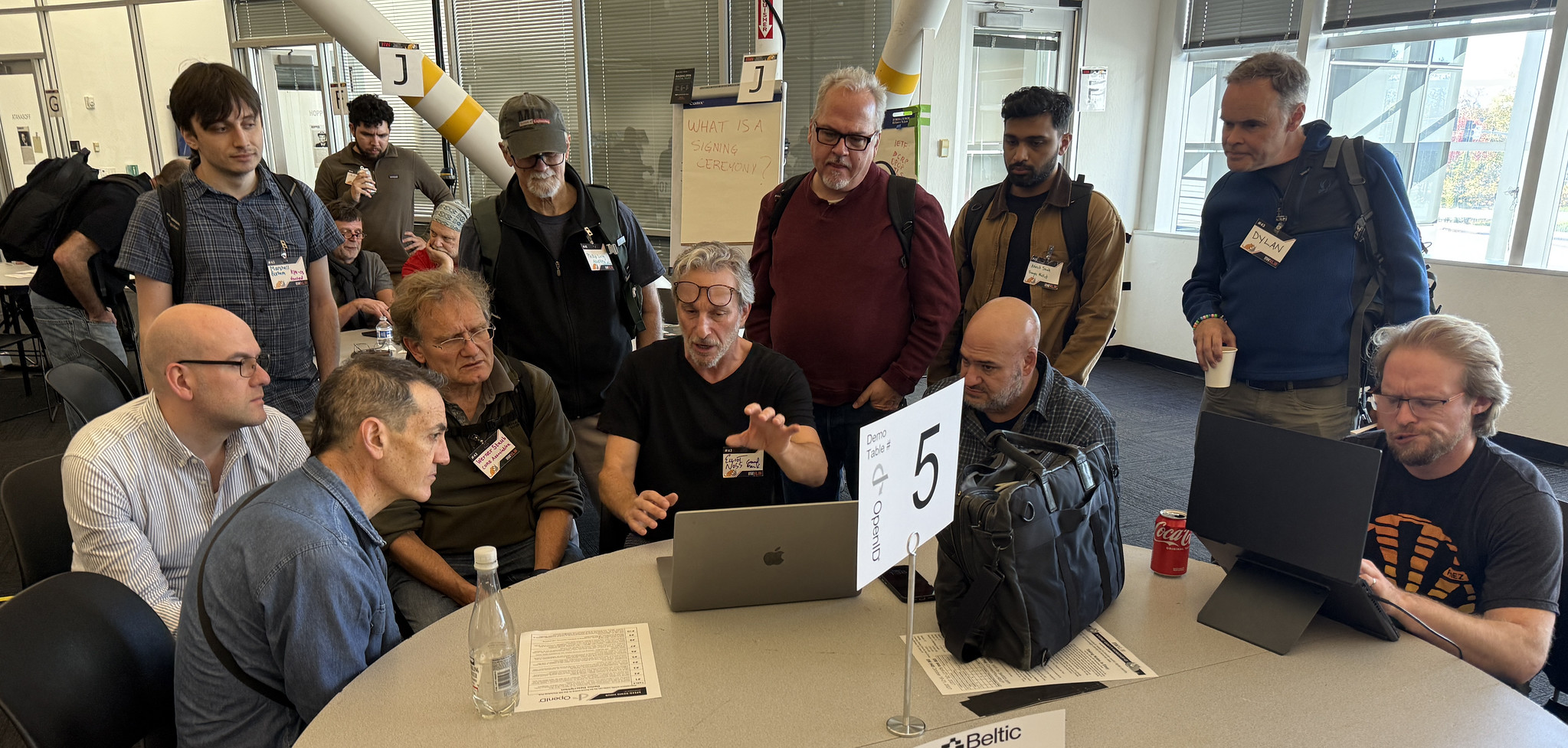
The infrastructure tables showed a stack that is growing up. Joseph Heenan walked through the OpenID Foundation's conformance tests, which let wallets, verifiers, and issuers certify their implementations of the HAIP profiles of OpenID4VCI and OpenID4VP. Junius Ho showed Affinidi's Predicate Credential System, a zero-knowledge approach to anonymous verification used to vet Linux kernel contributors. Michel Sahli showed Swisscom onboarding a company as a client or supplier in five minutes, and Sandeep Dhankar showed WebFrolic, an identity provider that builds expiring assignments, audit logs, and access policies into every resource from the start.
The agent demos matter because delegation is how authority flows from a person to software. If that authority can't be scoped, checked at the moment of use, audited, and revoked, then the agent is really acting for whoever runs it, and the person is just the account it's billed to. I've spent much of the past year writing about authorization and agentic AI, so it was good to see twenty tables of people building the pieces. The identity work was necessary. Holding delegated authority accountable is the work now.
Looking Ahead
Each IIW is a fresh expression of where the community is, because the community writes the agenda. IIW 43 showed a community that has largely settled whether agents need identity and is now working out how a person's authority travels with an agent, stays within bounds, and can be taken back. Those are not merely technical questions. They decide whether agents extend people's autonomy or quietly replace it with someone else's.
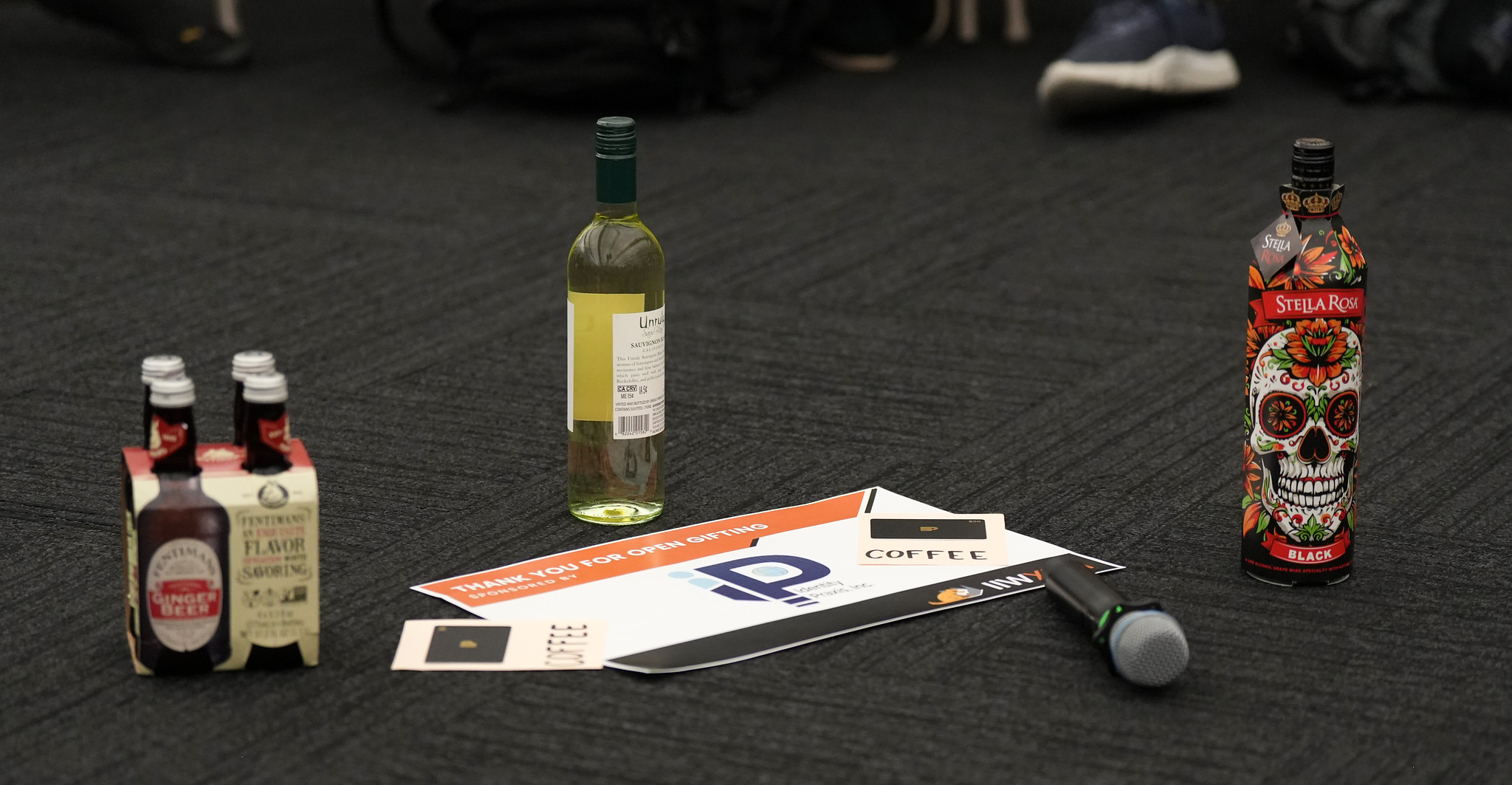
Huge thanks to everyone who convened a session, asked a hard question, staffed a demo table, or pulled someone into a hallway conversation. That's what makes IIW work, and it has now worked 43 times. The book of proceedings will be out soon with session notes, links, and other details. You can also see all of Doc's photos of IIW 43.
Mark your calendars: IIW 44 is April 27–29, 2027. Sponsorships are available now. Until then, keep building.
Photo Credit: IIW XLIII Photos from Doc Searls (CC BY 4.0)