Human in the Loop Control for OpenClaw
Some agent actions are too consequential to leave to policy alone. This post describes a new OpenClaw demo that uses Cedar and a Yubikey to put a human in the loop, binding each approval to the exact action being approved. Because the control lives in the harness rather than the prompt, the agent can't reason its way around it.
Continue reading {Human in the Loop Control for OpenClaw}
Authentication Is Largely Solved. Authorization Isn't.
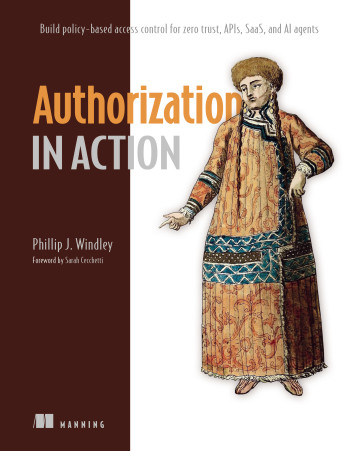
My new book, Authorization in Action, is out from Manning. It's about the question that comes after we know who you are: what are you allowed to do, under what conditions, on whose behalf, and in what context? Authentication is largely a solved problem; authorization is not, and AI agents are about to make that gap impossible to ignore.
Continue reading {Authentication Is Largely Solved. Authorization Isn't.}
Delegation as Data: Applying Cedar Policies to OpenClaw Subagents
Intra-domain delegation enables an agent to grant constrained authority to subagents without expanding the system’s trust boundary. In the OpenClaw + Cedar demo, delegation is modeled as data and enforced by a stable policy set, preserving policy integrity while allowing dynamic scoping of power.
Continue reading {Delegation as Data: Applying Cedar Policies to OpenClaw Subagents}
Childproofing the Control Plane: Using Cedar to Build Frontal Lobes for Agentic Systems
Connecting an agent like OpenClaw to Home Assistant can make home automation more adaptive and intelligent, but it also introduces real risks if authority is not clearly bounded. By externalizing decision logic into deterministic Cedar policies, we can create governed autonomy that allows agents to act usefully while preventing them from crossing safety, security, and privacy boundaries.
Continue reading {Childproofing the Control Plane: Using Cedar to Build Frontal Lobes for Agentic Systems}
Beyond Denial: Using Policy Constraints to Guide OpenClaw Planning
OpenClaw agents plan, adapt, and act over time, so authorization that functions merely as a reactive gate isn't the best architecture. In this post, I show how integrating Cedar's query constraints and Typed Partial Evaluation lets OpenClaw discover what is allowed before acting. The result is an agent that plans within policy-defined boundaries while still enforcing every concrete action at runtime.
Continue reading {Beyond Denial: Using Policy Constraints to Guide OpenClaw Planning}
Early Access to Dynamic Authorization
The first six chapters of my new book, Dynamic Authorization: Adaptive Access Control, are now available in Manning’s Early Access Program. The book explores why authorization is still misunderstood, and how new tools like Cedar enable secure, flexible systems that also improve employee and customer experience.
Continue reading {Early Access to Dynamic Authorization }
Why Do Policy Languages Feel So Hard?
Policy languages can feel intimidating due to unfamiliar syntax, poor tooling, and the high stakes of getting access control wrong. But once understood, they simplify application logic and make security more reliable and maintainable.
Continue reading {Why Do Policy Languages Feel So Hard?}

Explore Technometria
Popular Topics
- Actor Model
- Agentic AI
- Authentication
- Authorization
- Blogging
- Decentralization
- Event Programming
- Identity
- IIW
- Internet of Things
- IT Conversations
- Javascript
- KRL
- Kynetx
- Picos
- Programming
- Programming Languages
- Reactive Programming
- Reputation
- Sovrin
- Startups
You Might Also Enjoy
- Self-Sovereign Identity References
- Best Food Blog on the Planet
- Live Web Whitepapers
- My Slides
- My Videos
- CTO Breakfast
- Essays
- CIO Whitepapers
My Books